
Adjustment Disorder vs. Anxiety: How to Tell the Difference
Major life changes are stressful.
A breakup. A move. Starting college. Losing a job. Becoming a parent. A medical diagnosis.
It’s normal to feel overwhelmed during transitions.
But sometimes people begin to wonder:
Is this just stress?
Is this anxiety?
Why am I not bouncing back?
Understanding the difference between adjustment disorder and anxiety disorders can help you decide what type of support might be helpful.
What Is Adjustment Disorder?
Adjustment disorder occurs when someone has difficulty coping with a specific life stressor.
The key features are:
Emotional or behavioral symptoms in response to an identifiable stressor
Symptoms begin within three months of the event
Distress feels out of proportion to the situation
Daily functioning is impacted (school, work, relationships)
Common triggers include:
Starting high school or college
Relationship conflict or breakups
Family conflict
Job changes
Relocation
Chronic illness diagnosis
Identity transitions
Adjustment disorder is not a sign of weakness. It is a nervous system response to change.
For high school students, college students, and adults navigating life transitions, adjustment concerns are incredibly common.
What Is an Anxiety Disorder?
Anxiety disorders are characterized by persistent, excessive fear or worry that may or may not be tied to a specific event.
Unlike adjustment disorder, anxiety disorders:
Often persist beyond six months
May not be linked to a single identifiable trigger
Can include panic attacks
May involve avoidance behaviors
Tend to be recurring or chronic
Examples include:
Generalized anxiety
Social anxiety
Panic disorder
Anxiety disorders often involve a heightened baseline level of nervous system activation.
Key Differences: Adjustment Disorder vs. Anxiety
Here’s a simplified breakdown:
Adjustment Disorder :
Triggered by a specific stressor
Begins within 3 months of event
Often resolves when stressor improves
Directly tied to life change
Anxiety Disorder
May or may not have a clear trigger
Can develop gradually or suddenly
Often persists without treatment
Can generalize to many areas
That said, the line is not always perfectly clear. Sometimes adjustment stress can evolve into an anxiety disorder if not addressed.
When Is It More Than “Normal Stress”?
It may be helpful to seek therapy if you notice:
Difficulty sleeping most nights
Increased irritability or anger
Panic symptoms (racing heart, shortness of breath)
Loss of motivation
Social withdrawal
Thoughts of hopelessness
Increased conflict in relationships
For some individuals — particularly men, neurodivergent adults, and high-achieving students — stress may show up as anger, emotional shutdown, or physical symptoms rather than obvious worry.
Why Transitions Hit So Hard
Life changes challenge three major psychological needs:
Predictability – We lose a sense of control.
Identity – We may not know who we are in this new phase.
Attachment – Our relationships and support systems shift.
For individuals with prior trauma, chronic illness, or neurodivergence, transitions can be especially activating because the nervous system is already working harder to regulate.
How Therapy Can Help
Therapy for adjustment concerns or anxiety often focuses on:
Emotional regulation skills
Processing the meaning of the transition
Reducing avoidance patterns
Identifying cognitive distortions
Building coping strategies
Strengthening identity stability
For some clients, short-term therapy (3-6 months) is enough to restore equilibrium.
For others, adjustment stress reveals deeper patterns worth exploring.
Weekly therapy is usually suggested to get a hold of what is happening.
FAQ
Is adjustment disorder temporary?
Often, yes. Symptoms typically decrease once the stressor resolves or the individual adapts. However, support can speed up that process.
Can adjustment disorder turn into depression or anxiety?
Yes. If stress becomes chronic or coping resources are overwhelmed, or more harmful coping skills are being used, more persistent disorders, even in addition to general anxiety or depression, can develop.
Do I need therapy if I’m still functioning?
Functioning and thriving are not the same thing. Many high-performing individuals experience significant internal distress that deserves attention. Sometimes, a person can have a dysfunctional way of dealing with change that is helpful to have a therapist look into.
Final Thoughts
Struggling during a life transition does not mean something is wrong with you.
It means you are human.
If you are navigating a major change and feeling stuck, overwhelmed, or unlike yourself, therapy can provide structure, perspective, and tools to help you move forward with greater stability.
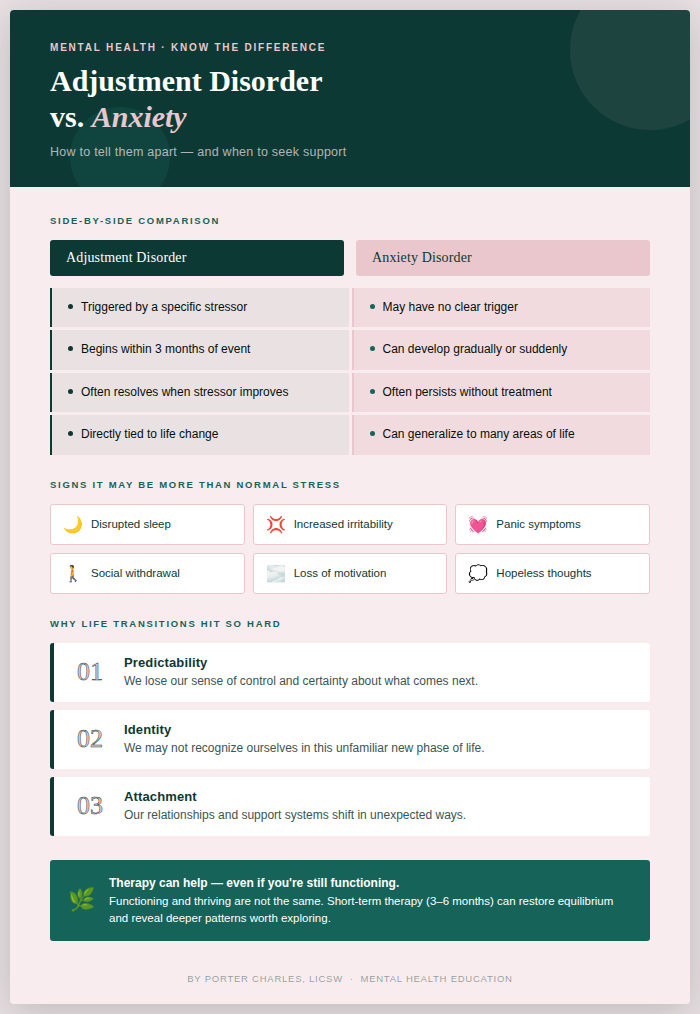
Image generated using Anthropic, Claude 2025
Be sure to check out our videos on social media and our shop for more education and motivation.



This handout breaks down 7 early warning signs of psychosis in language that actually makes sense to young people.
No clinical jargon, no scare tactics — just clear, relatable descriptions a high schooler or college student can read and recognize.
Includes a plain-language reminder that these signs don't equal a diagnosis, and a simple prompt to talk to a trusted adult. Print it, post it, or share it digitally.
-For Canva copy to edit colors, etc., please email us. Pricing slightly increases for this featured version.