
The Human Edge: Rising Emotionally in an Age of Artificial Intelligence
As machines grow smarter, our most urgent work remains deeply, irreducibly human. A call to finally close the emotional gap passed down through generations.
I have sat across from thousands of people in my therapy room over the past decade. Young adults who cannot name what they are feeling beyond “fine” or “stressed.” Middle-aged parents who love their children fiercely and yet repeat, almost word for word, the same hurtful phrases their own parents used on them. Couples who are not cruel to one another — they are simply fluent in a language that was never designed to build connection. What they share, in almost every case, is not a lack of love. It is a lack of emotional fluency. A deficit in what researchers now call Emotional Intelligence — and it is, I believe, the defining human challenge of our time.
This is not a comfortable article to write. It is, however, a necessary one. Because something is shifting in the world right now, something technological, something cultural, and I think it is handing us a rare and fragile opportunity. An opportunity to finally, as a civilization, grow up emotionally.
What We Mean When We Say “Emotional Intelligence”
The term gets thrown around a great deal, often reduced to “being nice” or “having good vibes.” It is considerably more than that. Let's get on the same page.
DEFINITION: Emotional Intelligence (EI): First formally described by psychologists Peter Salovey and John D. Mayer in 1990, and later popularized by science journalist Daniel Goleman, Emotional Intelligence is the capacity to recognize, understand, manage, and effectively use emotions. Both in ourselves and in our interactions with others. It is not the suppression of emotion. It is not emotional performance or strategic manipulation. It is the development of an inner life that is both honest and skillful. One that allows us to feel fully, respond wisely, and connect authentically.
Goleman identified four core domains of Emotional Intelligence, each building on the last:
Self-Awareness:
The ability to recognize your own emotions as they arise. To name them accurately, understand their triggers, and see how they influence your thoughts and actions.
Self-Regulation:
The capacity to manage your emotional responses. Not by suppressing them, but by pausing, processing, and choosing how you act rather than simply reacting.
Social Awareness:
The skill of reading the emotional landscape of others. Understanding their feelings, needs, and perspectives with genuine empathy rather than assumptions.
Relationship Management:
The ability to use emotional awareness to guide interactions. To inspire, influence, resolve conflict, and build trust in healthy, reciprocal ways.
These are learnable skills. That is the part that gives me hope every single day as I see the state of the world. They are not fixed traits that some people are born with, and others are not. They are capacities that can be developed at any age, at any stage of life, by anyone willing to do the work.

The Inheritance We Never Asked For
To understand where we are, we need to understand where we came from. Because the emotional habits of a culture do not disappear overnight. They travel silently, stubbornly, through families and generations, written into the way we respond to a crying child, to a difficult conversation, to our own pain.
Consider the phrases that shaped so many of us. “Suck it up.”“Stop crying or I’ll give you something to cry about.”“Be a man.”“You’re too sensitive.”“Get over it.” These were not expressions of intended cruelty, in most cases. They were expressions of a worldview, one that treated emotion as weakness, vulnerability as danger, and toughness as the highest virtue. They were spoken by people who were themselves never taught any other language.
“The pain of emotional illiteracy does not end in childhood. It simply changes form, becoming the addiction, the failed marriage, the leader who rules through fear, the parent who swore they would be different.”
We now understand, through decades of developmental psychology and neuroscience, the damage that many of these approaches caused.
Physical punishment: spanking, hitting. Does not teach children to behave. It teaches them to fear, to comply through coercion, and to associate love with pain.
Yelling as a primary parenting or management tool activates the stress response system in children’s developing brains in ways that can affect emotional regulation for a lifetime.
Dismissing emotions doesn’t make them go away; it drives them underground, where they emerge later as anxiety, depression, explosive anger, or a profound inability to feel safe in relationships.
None of this means the generations who raised us were necessarily bad people. It means they were doing the best they could with what they had. But that inheritance, that emotional vocabulary of suppression, shame, and force, has carried a cost that we are still paying today. And we have a choice, right now, about if we are going to do the work so we don’t pass it forward.
The cost no spreadsheet can capture
Emotionally unintelligent leadership costs organizations billions annually in turnover, disengagement, and toxic culture. I see this as I work with clients who are silently struggling, hoping their boss gets fired or protects them so they can breathe at work; for many, they end up looking for a new job. Emotionally unintelligent parenting contributes to youth mental health crises that have reached alarming levels globally. Emotionally unintelligent relationships, they don’t have to be abusive ones necessarily, but simply clumsy, unaware, poorly regulated ones, are the quiet epidemic behind nearly every therapy session I conduct.
We have built extraordinary systems. Our technology is breathtaking. Our productivity tools, our medical advances, our global connectivity are all remarkable. And yet the average person still does not know how to have a difficult conversation without defensiveness, how to comfort someone in grief without immediately trying to fix them, how to motivate another human being without resorting to fear or guilt. That gap, between what we can build and who we are, in my opinion, is the central crisis of our moment.
The Unexpected Gift of Artificial Intelligence
Something remarkable is happening right now, and I want to name it carefully, because I think we risk missing it entirely if we are not paying attention.
For the first time in human history, a significant portion of the cognitive and administrative burden of daily work is beginning to shift. Artificial intelligence is absorbing tasks that once consumed enormous amounts of human time and mental energy: research, drafting, scheduling, data analysis, customer service, logistics, writing, and even diagnosis in certain medical contexts, and the pace of this is accelerating.
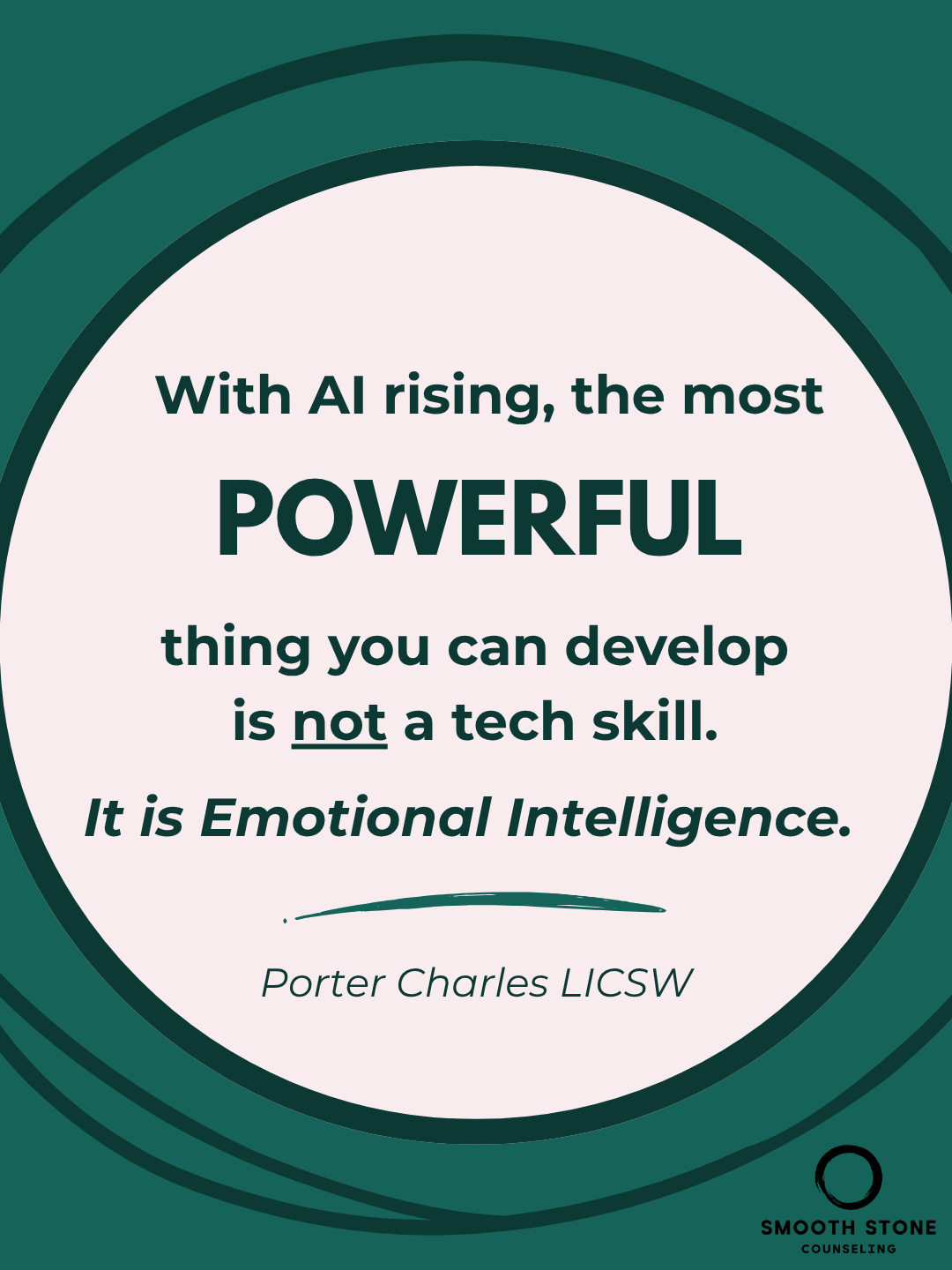
This is an opening, an opportunity. When machines handle more of the transactional weight of human life, something precious becomes available: Time. Space. The bandwidth to turn our attention toward what machines fundamentally cannot do and likely never will. To feel. To connect. To heal.
I am not naive about the disruptions AI is creating. The economic anxieties are real. The displacement is real. And here is something else that is real: the world AI is ushering in will demand more of us emotionally, not less. Adapting to rapid technological change, learning new tools, shifting careers, and tolerating uncertainty are all significantly less distressing for people with strong emotional regulation and resilience. Emotional intelligence is not a luxury in this new landscape. It is a survival skill.
And yet AI is also offering us something we have not had before: the gift of reclaimed attention. For generations, the relentless demands of work and productivity have served, perhaps conveniently, as a distraction from the deeper questions. About the quality of our inner lives. The health of our relationships. The kind of people we are becoming. AI cannot answer those questions for us. It cannot sit with you in your grief. It cannot forgive. It cannot witness another person's suffering and be genuinely changed by it. It cannot love. The more of the transactional that machines absorb, the more we are called and freed to tend to the irreducibly human.
That is the gift hiding inside the disruption. We get to choose whether we use it.
What Emotional Intelligence Actually Changes
Emotional Intelligence is a practical set of skills that changes outcomes measurably and meaningfully.
The way we motivate others
The old model of motivation (carrots and sticks, fear and reward) is not just ethically questionable. Research consistently shows it is less effective, particularly for complex, creative, or intrinsically meaningful work. High emotional intelligence allows a manager, a parent, a teacher, or a partner to understand what truly drives another person, i.e., their values, their fears, their need for autonomy or belonging, and to engage that motivational landscape with skill and respect. The result is not just better performance. It is people who feel seen, who trust, and who bring their full selves to what they do.
The way we help others make decisions
Decisions are never purely rational. Neuroscientist Antonio Damasio’s landmark research showed that patients with damage to the emotional centers of their brain, who could reason perfectly well but could not feel, were paradoxically unable to make good decisions. Emotion and reason are not opposites; they are partners. Someone with high EI can help another person access the emotional information embedded in a difficult choice, the fear underneath the resistance, the grief underneath the anger, rather than simply debating pros and cons. This is the difference between manipulation and genuine support.
The way we raise children
Decades of research on what psychologist John Gottman called “emotion coaching” shows that children whose parents acknowledge and validate their emotions, rather than dismissing or punishing them, develop superior self-regulation, better academic performance, stronger friendships, and greater resilience in the face of adversity. The parent does not need to be perfect. They need to be present. To say: “I see that you’re angry. That makes sense. Let’s figure this out together.” Those words, spoken consistently, are some of the most powerful developmental tools we have ever discovered.
The way we experience our own lives
Perhaps most fundamentally, emotional intelligence makes life more livable. Not easier, that is not the promise. But richer, more coherent, more genuinely your own. When you can name what you feel, you are less at its mercy. When you understand your triggers, you can make choices rather than simply reacting. When you can sit with discomfort without immediately fleeing into distraction, you develop a relationship with yourself that becomes the foundation of everything else. Joy becomes fuller. Loss becomes something survivable. Meaning becomes accessible rather than perpetually just out of reach.
A Call to Action
I am asking something of you. Not just to read this and nod. Not to share it and move on. I am asking you to take one concrete step toward your own emotional development, and then another.
Learn to name your emotions with more precision (Affect labeling). There is a world of difference between “fine,” “content,” “relieved,” “grateful,” and “quietly joyful” and between “upset,” “embarrassed,” “humiliated,” “heartbroken,” and “betrayed.” The more precisely you can name what you feel, anf the more you are able to idenfity the difference between emotions, the more agency you have over how you respond to it. Researchers call this “emotional granularity,” and it has been shown to significantly reduce emotional reactivity and improve overall well-being.
Notice the phrases that still live in your mouth from the generations before you. The “just get over it,” you say to yourself. The eye roll when someone cries. The discomfort with stillness. These are inherited habits, and they can be unlearned. But only if you notice them first.
“The question is not whether machines will become more emotionally capable. The question is whether we will.”
Seek support if you need it. Therapy is not always for the broken. It is for the brave. It is for anyone who decides that the inherited patterns stop here, that their children, their partners, their teams, and their communities deserve someone who has done the work. Access to mental health support is expanding. The stigma, slowly, is lifting. This moment, right now, is exactly the right time to begin. One small step at a time.
And if you lead people, as a parent, a manager, a teacher, a coach, etc., I ask you to make this a priority in how you lead. Not as a soft add-on. As a core competency. Because the research is unambiguous: emotionally intelligent leadership produces better outcomes by every measure that matters, including the ones you cannot put on a spreadsheet.
We have tried “suck it up” for a very long time. We have the generational data. It has not worked the way we hoped. What if this is the generation that tries something different? What if, precisely at the moment that artificial intelligence is rising, we finally commit to the full flowering of our human emotional intelligence?
The machines are getting smarter. The only question that remains is whether we will, too.
Want to learn more? Have an idea for a blog topic? Reach out!
I personally recommend these excellent books:
**If you purchase these books using these links, then I will receive a small commission:
EMDR: If you are working through trauma and considering EMDR, 5 hrs 2 mins. (Link here)
If you want a more clinical approach + self-help tips written by the creator of the modality. 12 hrs 2 mins (Link here)
Panic and Severe Anxiety: If you want a step-by-step structure to help end panic attacks, I’ve seen this book change lives. 6hr 19 mins. (Link here)
General Emotional Intelligence: Simple advice we all need to hear again. 3hr 44 mins. (Link Here)
For adult children of emotionally immature parents. 6hr 50mins. (Link Here)
IFS “Parts work”: If you have an imagination and are ready for deep work, and want to increase self-compassion. 8 hrs 10 mins. (Link Here)



This handout breaks down 7 early warning signs of psychosis in language that actually makes sense to young people.
No clinical jargon, no scare tactics — just clear, relatable descriptions a high schooler or college student can read and recognize.
Includes a plain-language reminder that these signs don't equal a diagnosis, and a simple prompt to talk to a trusted adult. Print it, post it, or share it digitally.
-For Canva copy to edit colors, etc., please email us. Pricing slightly increases for this featured version.