
EMDR 101: What It Is, How It Works, and Who It Can Help
If you have heard the term "EMDR" floating around and wondered what it actually means, you are in the right place. Maybe a friend mentioned it, maybe you saw it on social media, or maybe you are thinking about starting therapy and want to know your options. Either way, this post will walk you through the basics in plain language, no psychology degree required.
So, What Is EMDR?
EMDR stands for Eye Movement Desensitization and Reprocessing. It is a type of psychotherapy developed in the late 1980s by psychologist Dr. Francine Shapiro. What started as an accidental observation during a walk in the park (she noticed that moving her eyes back and forth seemed to reduce the distress she felt about certain memories) has grown into one of the most well-researched trauma treatments in the world.
Today, EMDR is recognized as an effective treatment by major organizations, including:
The American Psychological Association (APA)
The World Health Organization (WHO)
The U.S. Department of Veterans Affairs, and
Many more
You Do Not Have to Have PTSD for EMDR to Work
This is one of the biggest misconceptions about EMDR, so let's clear it up right away.
Yes, EMDR works very well for people with Post-Traumatic Stress Disorder (PTSD). The research on that is strong. But EMDR is not only for people who have been through war, assault, or life-threatening events. It can help with a wide range of experiences, including:
Anxiety and panic attacks
Phobias
Grief and loss
Depression
Low self-esteem
Difficult childhood experiences
Relationship stress
Performance anxiety
And the starting point does not have to be a major trauma. You can begin with something as small as a moment when someone cut you off in line, and you felt embarrassed or dismissed, and that feeling has quietly followed you around ever since. The size of the memory is not the point. What matters is how your brain and body are holding onto it.
What Happens in the Brain During EMDR?
Here is where things get genuinely fascinating.
When you experience something stressful or upsetting, your brain's alarm system kicks in. The amygdala, which is the part of your brain that sounds the danger alert, lights up. In that moment, your brain is working hard just to survive the situation. It does not have time to neatly file everything away.
As a result, some memories do not get processed properly. Instead of being stored as a clear, organized memory with a beginning and an end, they get kind of stuck. They stay in a raw, fragmented state, often held in the hippocampus, the brain's memory hub, but not fully integrated into the rest of your experience. That is why, months or even years later, a smell, a sound, or a facial expression can suddenly bring the whole thing rushing back, almost as if it is happening right now.
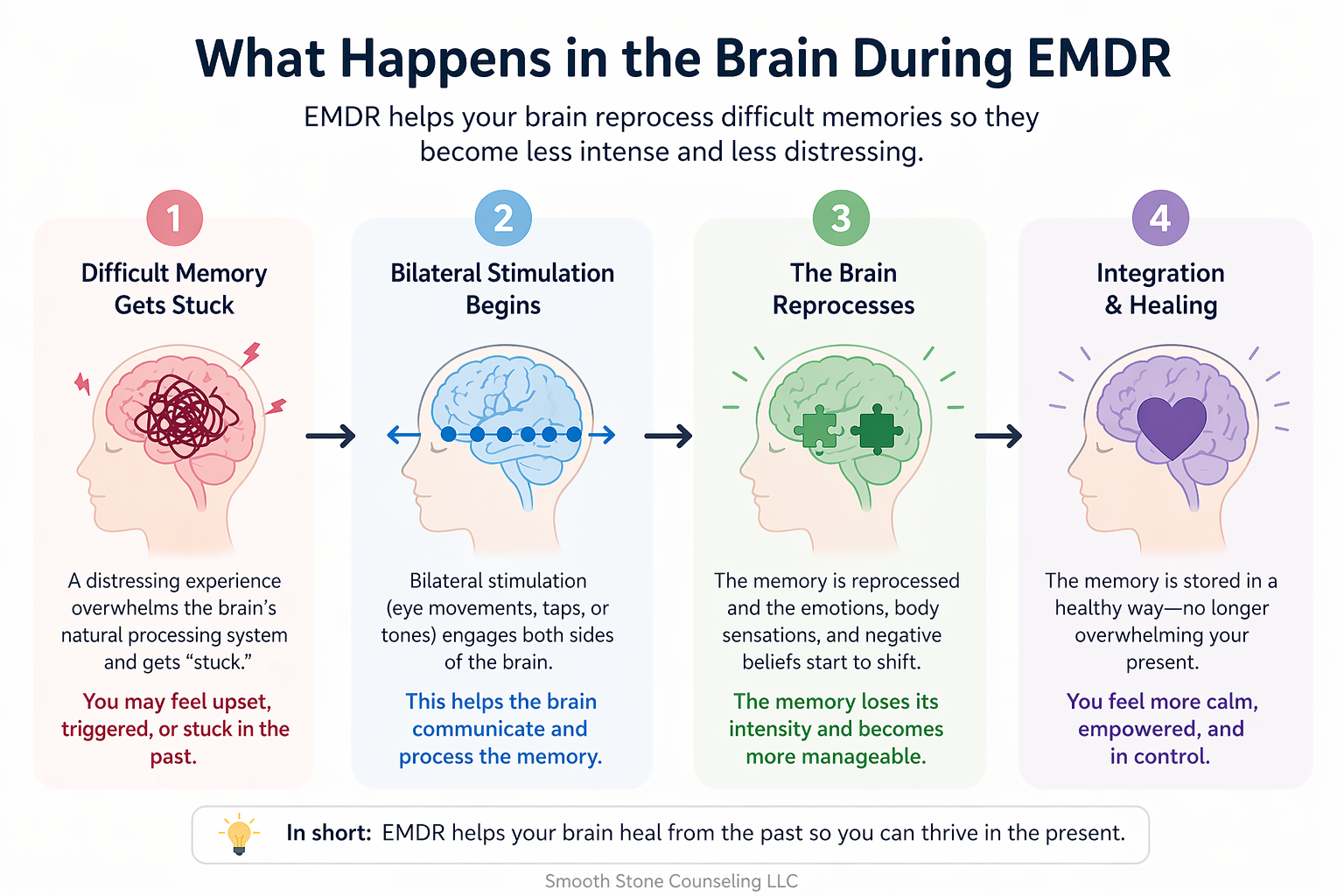
EMDR appears to help the brain do what it could not do at the time: finish processing the experience. Through the therapy, that stuck memory seems to move toward the prefrontal cortex, the front part of your brain that handles reasoning, perspective, and meaning-making. Once it gets there, you can look at the memory and know it is in the past. The emotional charge around it tends to drop significantly.
The REM Sleep Connection
Here is something most people find really interesting.
The bilateral eye movements used in EMDR look a lot like what happens during REM sleep (Rapid Eye Movement sleep), the stage of sleep when dreaming happens. Scientists have long believed that REM sleep plays a major role in how we process emotionally charged memories. During REM, the brain seems to sort through the day's experiences, connect them to existing memories, and drain some of their emotional weight.
EMDR may be doing something similar while you are awake. The bilateral stimulation (more on that in a moment) seems to activate the brain's natural processing system in a way that is comparable to what happens during a good night of deep, restorative sleep. That is a compelling parallel, and it helps explain why EMDR can sometimes produce changes that feel surprisingly fast.
AI-generated illustration created with ChatGPT (OpenAI). Used for educational purposes
We Do Not Know Everything Yet, and That Is Okay
Honest moment: Researchers and clinicians are still working out exactly why EMDR works as well as it does.
The REM connection is a strong hypothesis. There are also theories involving working memory, suggesting that holding a distressing image in mind while simultaneously doing a task (like tracking hand movements) overloads the brain's capacity to keep the memory vivid, which weakens its grip. There are neurological explanations, psychological explanations, and plenty of ongoing debate among researchers.
What we do know with confidence is that across dozens of controlled studies, EMDR produces measurable, lasting results for a wide range of people. The field is continuing to grow and refine its understanding. Science is always a work in progress, and EMDR is no exception.
Bilateral Stimulation (BLS): The Back-and-Forth That Makes It Work
One of the most distinctive parts of EMDR is something called bilateral stimulation, often shortened to BLS.
"Bilateral" simply means "both sides." During EMDR, a therapist guides the client through some form of stimulation that alternates between the left side and right side of the body or sensory experience. This can look like:
Eye movements: Following the therapist's fingers or a light bar moving back and forth
Tapping: The therapist or the client gently tapping alternately on the client's knees, hands, or shoulders
Auditory tones: Listening to sounds that alternate between the left and right ear through headphones
Hand buzzers: Small devices held in each hand that vibrate alternately
The idea is that this rhythmic, side-to-side stimulation is what seems to "unlock" the brain's natural processing. While the client holds a piece of a difficult memory in mind, the BLS keeps the brain active in a way that allows the memory to shift and be reprocessed rather than just re-experienced.
Dual Attention Stimuli (DAS): Being in Two Places at Once
Closely related to BLS is the concept of Dual Attention Stimuli, or DAS, which is used in EMDR.
This refers to the client's ability to hold two things at the same time: the distressing memory or image on one hand, and the present moment on the other. You are aware of the past while remaining rooted in the now.
This is actually a crucial part of what makes EMDR work. You are not diving so deep into a memory that you lose yourself in it. You are keeping one foot in the present, in the safe room with your therapist, while the other foot steps toward the difficult material. The bilateral stimulation helps anchor that present-moment awareness.
Many clients describe this as the difference between being swept away by a wave versus watching the wave from the shore. DAS keeps you on the shore even as you observe the water.

AI-generated illustration created with ChatGPT (OpenAI). Used for educational purposes
What Does an EMDR Session Actually Look Like?
EMDR is not just a technique you pick up and use in a single session. It follows a structured, eight-phase protocol that has been developed and refined over decades of clinical work and research. Those phases include:
History taking and treatment planning - Understanding your history and what to work on
Preparation - Building coping tools and explaining the process
Assessment - Identifying the specific memory and related thoughts and feelings
Desensitization - The active processing phase with BLS/DAS
Installation - Strengthening a positive belief to replace the old one
Body scan - Noticing and addressing any residual tension in the body
Closure - Bringing the session to a safe end
Reevaluation - Checking in at the next session
Skipping or rushing these phases is not just unhelpful; it can be counterproductive. The protocols exist for good reason. They were not invented arbitrarily. They reflect decades of trial, error, research, and clinical wisdom about how to help people process difficult material safely and effectively.
Are You Doing It Right? A Note on "Good Enough"
One thing I often hear from clients is some version of: "Am I doing this correctly? I'm not sure I'm doing it right."
Here is what I want you to know: EMDR is not a performance.
If the images you get are blurry or you cannot quite picture anything, that is fine. If your mind wanders to something that seems unrelated, that is actually often the processing happening. If you feel emotional, or if you feel surprisingly calm, both are okay. If something unexpected comes up, that is not a sign that something has gone wrong.
Your therapist is there to guide you and adjust as needed. Trust the process, trust your therapist, and trust that your brain is doing more than it may look like from the inside.
What If It Did Not Work for You, or You Had a Bad Experience?
This is worth talking about honestly, because some people have tried EMDR and walked away feeling like it did not help, or even that something went wrong. If that is you, please know that that experience is real, and it deserves to be taken seriously. It also does not mean EMDR cannot help you, or that you are somehow not able to be helped.
There are a few common reasons EMDR does not go well.
The clinician may not have had enough experience. EMDR is a skill, and like any skill, it takes time to develop. A therapist who completed basic training but has not done much EMDR since, or who has not worked with cases like yours before, may move too fast, skip important preparation steps, or not know how to handle what comes up in session. This is not about blaming the therapist. It is just the reality that experience matters enormously in this work, and a difficult EMDR experience is often a reflection of the fit and the clinician's depth of training rather than a reflection of you or the therapy itself.
The client may not have been quite ready yet, and that is completely okay. EMDR asks a lot. It asks you to turn toward difficult material on purpose, with intention, and that takes a certain kind of readiness. Sometimes people come to EMDR before they have enough stabilization or coping resources in place. Sometimes life circumstances make it hard to do deep processing work. Sometimes the timing is just not right. None of that is a failure. It just means the groundwork was not fully laid yet. Coming back to EMDR later, with more preparation or a different therapist, can make all the difference.
Sometimes the block is part of the trauma itself. This one surprises people. For some clients, part of their history involves feeling like they cannot do things right, or that getting better is not allowed, or that healing is somehow dangerous or undeserved. When those beliefs are wrapped up in the trauma, they can create real resistance in the EMDR process. A skilled clinician will recognize this and work with it directly rather than pushing through it. It is not a dead end. It is just another layer to address.
A note on benzodiazepines. This is something I think every client considering EMDR should know about. There is research suggesting that benzodiazepines, which are medications like Xanax, Klonopin, Ativan, and Valium, may interfere with how well EMDR works. The thinking is that these medications suppress the emotional and memory consolidation processes that EMDR depends on, essentially keeping the brain from fully engaging with the processing. This does not happen in every case, and it does not mean you cannot do EMDR if you take one of these medications. But it is an important conversation to have. A good EMDR therapist will ask about your medications and will want to discuss this with you openly. If yours has not brought it up, it is worth raising yourself.
The bottom line is this: a difficult past experience with EMDR is information, not a verdict. It is worth understanding what happened before deciding the door is closed.
What EMDR Is Not
Just to round things out:
EMDR is not hypnosis. You are awake, alert, and in control the entire time.
EMDR is not magic. It is evidence-based therapy, and it takes time and effort.
EMDR is not one-size-fits-all. A trained therapist will assess whether it is a good fit for you and your specific situation.
EMDR is not a shortcut around the hard work. It can move things faster than some other approaches, but it still requires courage, commitment, and a good therapeutic relationship.
EMDRIA: The Gold Standard for Training and Certification
When you are looking for an EMDR therapist, you may come across the name EMDRIA, which stands for the EMDR International Association. EMDRIA is the leading professional organization for EMDR practitioners, and it is respected worldwide. There is no other association or organization that comes close to matching its level of credibility, research standards, and clinical oversight in the EMDR world.
EMDRIA offers certification for therapists who meet specific training hours, consultation hours, and continuing education requirements.
Here is the important thing to understand: a therapist does not legally need EMDRIA certification to practice EMDR. Basic EMDR training is enough to get started. But certification through EMDRIA signals that a clinician has gone significantly beyond the basics. It means they have put in the extra time, supervision, and study to demonstrate a higher level of competence. Think of it like the difference between someone who took a weekend cooking class and a trained chef. Both can make you dinner, but the experience level is very different.
That said, certification isn’t the only marker of quality. A non‑certified therapist may be an excellent choice, and an EMDRIA‑certified therapist may not be the best fit for every client. EMDRIA certification simply standardizes and quantifies experience, and clinicians must pay annually to maintain it after earning it.
Certification is not the only thing that matters. What is most important is that you ask questions. How much EMDR training has your therapist completed? How long have they been practicing it? Have you used EMDR on the issue I want to work on before? A good therapist will welcome those questions.
And if something does not feel right, it is completely okay to find someone else. This is true in any area of therapy, and EMDR is no different. Some clinicians are more skilled and experienced at this work than others. Some feel more connected to you than others, that’s normal. Finding the right fit is not a failure; it is smart self-advocacy.
If you are looking for an EMDR therapist, I recommend starting with the EMDRIA therapist directory, which allows you to search by location and specialty. You can find it at www.emdria.org. From there, other general therapist directories can also be helpful for broadening your search, but EMDRIA's directory is, in my opinion, the best place to start when EMDR is specifically what you are looking for.



EMDRIA digital badges are a way to easily share and validate your credential achievements. Above are what they look like. (more info)
What Is an EMDR Intensive?
Most therapy happens in the familiar 45-53ish-minute weekly appointment. You come in, you do some work, you leave, and you come back next week. That model works well for a lot of people. But for some, it can feel slow, especially when you know there is something specific you want to work through, and you are ready to move.
That is where EMDR intensives come in.
An EMDR intensive is simply a longer, concentrated EMDR session or series of sessions. Instead of 50 minutes, you might work for 2, 3, or 4 hours in a single day. Some practitioners offer intensives of up to 6 or even 10 hours, though most commonly you will see half-day formats of around 3 to 4 hours. Some intensives are spread across consecutive days, almost like a retreat for your nervous system.
The idea is that by dedicating a longer block of time to the work, you can go deeper without having to stop right when things are moving, and without losing momentum between weekly appointments. EMDR processing tends to build on itself. Longer sessions allow the brain to follow a thread further before wrapping up, which can mean more complete processing in less overall time.
One of the things I find most meaningful about EMDR in general is that the work tends to stick. Unlike some approaches where you might feel better temporarily and then backslide, EMDR seems to create lasting shifts in how a memory is stored and experienced. Intensives carry that same quality. People who do them often describe significant, noticeable changes in their day-to-day life relatively quickly.
There is one important practical note: EMDR intensives are not covered by insurance. They are an out-of-pocket investment. For people who have the ability to access them, the feedback is typically very positive. For those for whom weekly therapy is the right fit financially or logistically, that path absolutely still works. Intensives are simply an option worth knowing about, particularly if you are motivated to process something specific and want to do it with focused attention rather than stretched over time.
The Different Types of EMDR You Might Find Online
If you start searching for EMDR therapists or reading about EMDR, you will quickly notice that there are a lot of variations and specialty approaches out there, and it can feel confusing. Here is a quick guide to what some of those mean.
EMDR 2.0 is an updated version of the standard protocol developed by Dutch researchers. It incorporates findings from working memory research and makes some adjustments to how the bilateral stimulation is used during processing. It is still EMDR at its core, just with some refinements based on newer science.
Relationship-focused EMDR addresses the way early attachment experiences and relational wounds show up in our relationships. Some therapists are specifically trained to use EMDR to target the beliefs and memories underneath patterns like fear of abandonment, difficulty trusting others, or chronic people-pleasing.
Trauma-specific EMDR approaches exist for particular populations and experiences, including first responders, sexual trauma survivors, complex trauma (sometimes called C-PTSD), and more. Some therapists have done advanced training in working with dissociation, which requires a careful and modified approach to standard EMDR protocols.
EMDR for performance and anxiety is used by athletes, performers, and professionals who want to clear the mental blocks, fear of failure, or past experiences that are getting in the way of doing their best work. It is the same underlying process applied to a different kind of goal.
Here is the most important thing to know about all of this: just because a therapist does not list a specialty on their website does not mean they cannot help you with it. Many experienced EMDR clinicians have done advanced trainings in specific areas and simply have not updated their website to reflect every single thing they are capable of. Let’s be honest, it would be long, and you probably would not read it. Websites are often a snapshot, not the full picture.
So before you rule someone out or spend a lot of time hunting for the perfect specialty match, reach out and ask. A simple question like "I am hoping to work on [specific issue], do you have experience using EMDR for that?" can tell you a lot. If the therapist answers with confidence, gives you some context about their background with it, and the conversation feels comfortable, that is a good sign. The fit between you and the therapist matters just as much as the specialty label.
Key Research to Know
For those who want to go deeper, here are some foundational and well-regarded research articles and resources in the EMDR field:
Shapiro, F. (1989). Eye movement desensitization: A new treatment for post-traumatic stress disorder. Journal of Behavior Therapy and Experimental Psychiatry, 20(3), 211-217.
Van den Hout, M. A., & Engelhard, I. M. (2012). How does EMDR work? Journal of Experimental Psychopathology, 3(5), 724-738.
Bisson, J. I., Roberts, N. P., Andrew, M., Cooper, R., & Lewis, C. (2013). Psychological therapies for chronic post-traumatic stress disorder (PTSD) in adults. Cochrane Database of Systematic Reviews, Issue 12.
Lee, C. W., & Cuijpers, P. (2013). A meta-analysis of the contribution of eye movements in processing emotional memories. Journal of Behavior Therapy and Experimental Psychiatry, 44(2), 231-239.
Stickgold, R. (2002). EMDR: A putative neurobiological mechanism of action. Journal of Clinical Psychology, 58(1), 61-75. (This is the paper that explores the REM sleep connection in depth.)
Maxfield, L., & Hyer, L. (2002). The relationship between efficacy and methodology in studies investigating EMDR treatment of PTSD. Journal of Clinical Psychology, 58(1), 23-41.
World Health Organization. (2013). Guidelines for the Management of Conditions Specifically Related to Stress. Geneva: WHO. (EMDR is listed as a recommended treatment alongside trauma-focused CBT.)
Shapiro, F. (2018). Eye Movement Desensitization and Reprocessing (EMDR) Therapy: Basic Principles, Protocols, and Procedures (3rd ed.). Guilford Press. (The primary clinical textbook for the field.)
Interested in starting EMDR?
If you are curious about whether EMDR might be a good fit for you, I would love to talk. Every person's history is different, and the first step is always a conversation.
Disclaimer: This post is for educational purposes only and does not constitute clinical advice. Please consult a licensed mental health professional to determine what treatment is right for you.
Want to learn more? Have an idea for a blog topic? Reach out!
I personally recommend these excellent books:
**If you purchase these books using these links, then I will receive a small commission:
EMDR: If you are working through trauma and considering EMDR, 5 hrs 2 mins. (Link here)
If you want a more clinical approach + self-help tips written by the creator of the modality. 12 hrs 2 mins(Link here)
Panic and Severe Anxiety: If you want a step-by-step structure to help end panic attacks, I’ve seen this book change lives. 6hr 19 mins. (Link here)
General Emotional Intelligence: Simple advice we all need to hear again. 3hr 44 mins. (Link Here)
For adult children of emotionally immature parents. 6hr 50mins. (Link Here)
Non-religious forgiveness and relief from letting go with in-book exercises: (Link here)
IFS “Parts work”: If you have an imagination and are ready for deep work, and want to increase self-compassion. 8 hrs 10 mins. (Link Here)



This handout breaks down 7 early warning signs of psychosis in language that actually makes sense to young people.
No clinical jargon, no scare tactics — just clear, relatable descriptions a high schooler or college student can read and recognize.
Includes a plain-language reminder that these signs don't equal a diagnosis, and a simple prompt to talk to a trusted adult. Print it, post it, or share it digitally.
-For Canva copy to edit colors, etc., please email us. Pricing slightly increases for this featured version.