
How do You Keep Them in Your life? Let Them Live Their Own.
A Message for Parents Who Want What’s Best for Their Adult Children
If you're reading this, chances are you love your child deeply. You've invested years — emotionally, physically, financially — in raising them. You've worried about them, celebrated them, and imagined futures for them. Your love is real.
But sometimes love, even the most well-intentioned love, can push in directions that hurt rather than help. Sometimes our love gets muddled with our own needs, expectations, and unspoken conditions.
This is a gentle, honest conversation about one common topic that creates trouble: the pressure some parents place on their adult children to date, marry, or have children, and why it feels so personal. This conversation may create some emotional responses for you. Write those down, pause reading, and come back to it, because it’s worth reading and considering if you want your child to feel the love you have for them, in the way they receive love.
This post isn't about blame or shame. It's about understanding — and ultimately, about protecting the relationship you have with your child. Because if you want an adult relationship with your adult child, it will take an evolution of the one you once had. That's not a loss. It's the only way to keep them in your life.
Your Child's Path May Not Look Like Yours — and That's Okay
When you imagine your adult child happy, what do you picture? For many parents, that image looks familiar — a partner, children of their own, holidays gathered around a big table, living close enough to visit, and eventually being there for you as you grow older. That picture comes from a place of love. It's often woven from your own life, your own ideals, and the future you quietly began building for them long before they had any say in it.
What we rarely pause to examine are the unspoken expectations we've already written into our child's story. It might be worth sitting with that for a moment — even putting pen to paper. What do you actually expect from your child's future? What have you assumed without ever saying out loud? Because those unspoken expectations have a way of showing up as disappointment, and disappointment has a way of showing up as pressure or even anger — which, more often than not, just causes distance. Not what you want.
Some parents envision a certain level of access to grandchildren, the ability to shape how they're raised, and the chance to give them something they never had. That desire comes from love. But here's something difficult and worth sitting with: many future or current grandparents, without realizing it, haven't done the deeper work of examining their own biases, values, and wounds. When grandchildren arrive, it's easy to project what we needed onto them, rather than truly seeing who they are and trusting the parents who are raising them.
A simple example: a grandparent spoils the grandchildren in ways the parents have asked them not to. The parents set a limit. And instead of receiving that the way we might receive any reasonable request from someone we respect — just adjusting, without resentment — the grandparent becomes hurt and defensive. Why does it land so hard? Often, because they've connected their own needs, their own history, maybe even their own unresolved pain to that child. So a simple boundary feels like a rejection of who they are. That's worth noticing. Because when we can separate our own story from theirs, we become so much easier to be close to. And when we do that deeper work on ourselves, we interrupt the cycles that quietly or not-so-quietly push our adult children toward distance — or toward an unhealthy sense of obligation to take care of us emotionally.
Our expectations shape our relationships more than we realize. If you find yourself expecting them to parent, partner, or live the way they did when they were under your roof, those expectations belong to you — not to them.
It can feel unsettling to watch your adult child do things they never would have done while living with you. But here's a reframe worth considering: that's actually a very good sign. While they lived under your roof, their role — consciously or not — may have been to keep the peace, to fit a certain mold, to manage how their choices might affect you or other family members. Now, as adults with the freedom to live on their own terms, they no longer have to factor in your emotional comfort as a condition of their own safety. They get to just be. That's not a loss of closeness — it's an invitation to build something more honest and deeper. And if you can meet them there with curiosity and support instead of correction, you may find you know them in a way you never quite did before. You might even be quiet plesanetly surprised.
Unmet expectations and pressure breed resentment, and resentment quietly poisons the very closeness you're trying to protect. If your child's choices leave you feeling dissatisfied or hurt, those feelings deserve your attention — but the answer isn't for them to reshape their life around your comfort. That work belongs to you.
One of the most important things to watch for in yourself is the belief — conscious or not — that your child is responsible for your happiness. Just because you raised them, they owe you the picture-perfect life you envisioned. The fantasy you held onto during the hard times, telling yourself it would all be worth it someday — when they had families of their own, when the pieces fell into place. If that belief was present as they were growing up, it likely left a mark they're still carrying. That's not said to shame you. It's said because naming it is the first step to changing it — and to building the real closeness you're longing for. Remember, negative impacts in parenting are a garenettee but it’s how we recover and deal with them that matters the most.
If this still feels uncomfortable and isn't quite landing, it may be worth asking yourself honestly: Am I seeking closeness, or am I seeking control? Am I trying to connect — or trying to soothe something in myself? These are not easy questions, and they're ones best explored with a therapist who can help you grow, evolve, and show up in a way that actually brings you closer to your child.
Relationships Are Not the Same as Happiness
It's a deeply human habit to look at someone else's life and measure it against what we would do, what we would want, what we would choose. But one thing that's almost never considered when a parent pushes their child toward a relationship is that child's inner world — their sexuality, their relationship with intimacy and closeness, how they experience connection and attraction.
Your child is a whole person with an interior life you may not have full access to. If you are heterosexual, it can be genuinely difficult to imagine what it feels like to be asexual — to experience little or no sexual attraction. If your child is in that experience, any relationship they enter needs to be built around who they actually are, not around what you expect a relationship to look like. Pressuring an asexual or aromantic person toward romantic partnership doesn't just cause discomfort — it tells them, quietly but clearly, that who they are is not acceptable to you. And when that's the message, they stop telling you things. Not out of secrecy, but out of self-protection.
Similarly, if your child grew up in a home or community where queer identity wasn't welcomed, they may be facing one of the loneliest kinds of decisions a person can face — whether to suppress who they are to stay connected to the only family and community they've ever known, or whether to step into their truth and risk losing that safety. That is an enormous weight. And it becomes heavier every time the people they love signal that acceptance is conditional.
Others may simply be in a season of life where partnership or parenthood isn't what they want or are ready for. They may have fears. They may have a vision for their life that looks nothing like the one you held for them, and that is not a problem to fix. What is worth examining is how your expectations are being communicated and whether that communication feels like love or like pressure.
Happiness doesn't have one shape. Your child can build a deeply fulfilling, joyful, connected life that looks nothing like yours — and that's not a failure. That's their freedom. The question is whether you want to be part of that life, on their terms. Because that's the only invitation that's truly on the table.

Pressure Doesn’t Lead to Partnership — It Leads to Resentment
When a child feels pressured to enter a relationship or start a family before they’re ready — or before they want to at all — something quietly breaks. They may comply. They may enter relationships for the wrong reasons, to relieve your or their anxiety rather than to meet their own needs. Relationships built on that foundation rarely thrive.
And even when they go along with it, they remember. They remember being pushed into a life stage they weren’t ready for. They remember that their “no” wasn’t honored. I may have even felt non-consensual for them. Over time, that accumulates — and it can quietly erode the very closeness you were hoping to protect.
The painful irony is this: the more you push, the further away they’re likely to pull.
A Hard Question Worth Sitting With
It takes courage to ask yourself: why do I want this for my child, really, and does happiness mean the same for them as it does for me?
If the answer includes wanting grandchildren, wanting to feel like your parenting “worked,” or wanting a certain kind of family life that feels comfortable and familiar to you — those are honest answers worth examining. They’re not shameful, but they are about your needs, not your child’s. And when we act on our needs through our children’s choices, we’re not supporting them — we’re burdening them.
Your child’s life choices don’t need to make sense to you for them to be right for your child. Their comfort doesn’t have to look comfortable to you. Needing their choices to mirror yours in order to feel okay is a sign that something in you — not them — needs tending to.
The Complicated Truth About Parenting and Entitlement
After years of raising a child — after the sleepless nights, the school runs, the teenage turbulence, the financial sacrifice — it can feel natural to expect something in return. Involvement. Access. A continued role in their story.
But children don’t choose to be born. They didn’t choose you as their parent. In the vast majority of cases, they had no say in how they were raised, what values were modeled for them, or what was expected of them. That doesn’t erase the love in the relationship — but it does mean that your adult child doesn’t owe you a particular kind of life in exchange for being raised.
Everyone, everyone, needs some form of self-reparenting when they move out and on from their parents’ home environment. Seeing your child not make the decisions you wanted them to make can be hard, but it can be easier if you can reframe it as you are excited to see how they will choose to grow and evolve now that you gave them as solid of a foundation as you could. You get to see how they perform in life, and you can cheer them on in their efforts.
The relationship you have with your adult child going forward needs to be one they genuinely want to be in — not one they feel obligated to maintain. The difference between those two things is everything.
Autonomy Is Not Abandonment
As your child moves through adulthood, your role naturally evolves — and that's not a bad thing, even when it feels like one. The parenting that served a five-year-old — guiding, directing, deciding — doesn't serve a twenty-five or thirty-five-year-old. Each stage of your child's development asks something different of you, and what adulthood asks, more than anything, is that you step back from making their decisions.
There's a meaningful difference between support and control, and it's worth sitting with honestly. Support sounds and feels like:
"I'm here if you need me — no pressure."
Listening without immediately jumping to advice or solutions
Validating their feelings even when you don't fully understand their choices
Offering your perspective only when they ask for it
Feeling genuine excitement when they succeed, because their wins belong to them
Control can be harder to recognize in ourselves, because it rarely feels like you're forcing control from the inside. It often shows up as:
Expressing disappointment in ways that are meant to be felt (i.e. disappointment, worry, and guilt) to get them to change their decisions.
Framing worry as love and using it to apply pressure to ease your discomfort.
Giving advice that wasn't asked for, repeatedly
Withdrawing warmth or connection when they don't make the choice you hoped for
Using guilt — consciously or not — to pull them back toward what you prefer
Control doesn’t have to be the forceful actions we commonly think of; emotional coercion is still coercion, even when it comes from love. We can’t use “love” this way, and we can’t confuse it with anxiety or other emotions if we want a healthy reciprocating relationship. One of those lists builds closeness. The other builds walls.
If your child is close to you primarily because they feel guilty, obligated, or afraid of your reaction — that's not closeness. That's compliance. And compliance, over time, quietly hollows out a relationship. Real connection is voluntary. It's chosen, freely, again and again. It cannot be pressured into existence, and anything built on pressure will eventually show cracks.
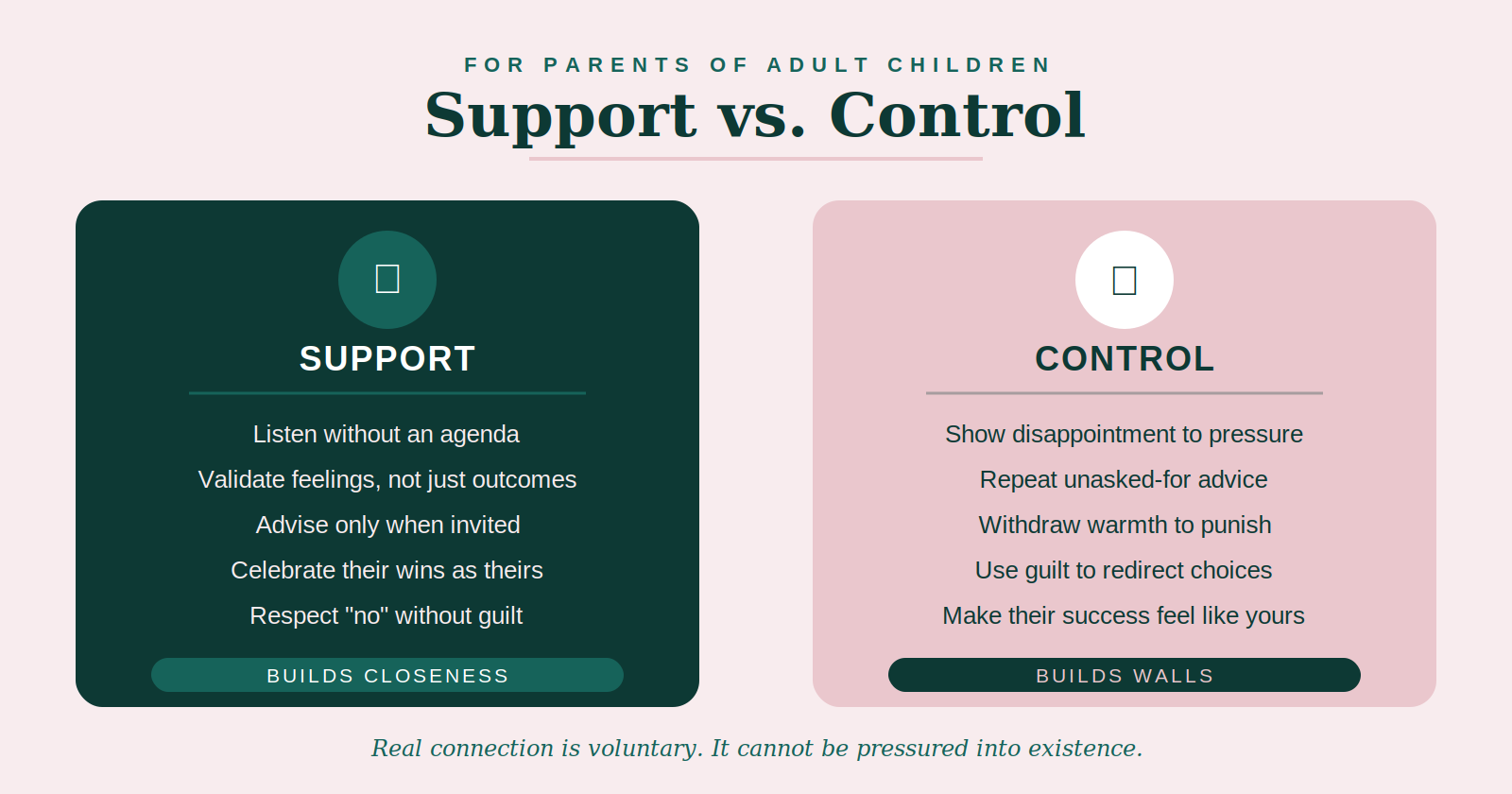
Image generated using Anthropic, Claude 2025
What to Do With Your Own Feelings
None of this means your feelings don’t matter. They do. It can be genuinely hard to let go of a vision you held for your child’s life. It can be truly painful to feel less needed, less included, less central to their story.
But those feelings are yours to carry, not theirs. Learning to sit with your own discomfort, to grieve expectations without placing the weight of that grief on your child, is one of the most important things you can do — for yourself and for your relationship with them.
If distance has grown between you and your adult child, it’s worth asking honestly: what role might my reactions, expectations, or pressure have played in that? Not to punish yourself — but to open a door. A therapist can be a tremendous resource here, if you are honest and open with them, not because something is “wrong” with you, but because this kind of self-examination is genuinely hard work and benefits from professionally guided support.
When you came into parenthood, you likely had no idea the full scope of what you were taking on. That’s true for almost everyone. The commitment to keep growing into it — at every stage, including this one — is one of the most loving things you can do.
The Invitation
Your child’s happiness — their real happiness, not the version of it you imagined — is the goal. And the path there runs through respect, not expectation. Through curiosity, not control, shame, or coercion masked as curiosity. Through a relationship they choose, again and again, because it feels safe and good — not because they feel they have no other option.
Be mindful of all-or-nothing thinking, especially if your adult child expresses a boundary or desire. We will discuss more on boundary setting ( both sides of it) in later blogs, so stay connected via the newsletter/subscribing
You don’t have to understand every choice your child makes. You don’t have to agree with it. You just have to decide that their right to make the decision matters more than your comfort with it.
That’s not a loss. That’s love at a mature level.
Note: Every family is different. Some situations — including where a child has additional support needs — may call for more nuanced conversations. Working with a therapist can help you navigate the specific dynamics of your relationship in a way that honors everyone involved.
Want to learn more? Have an idea for a blog topic? Reach out!
I personally recommend these excellent books:
**If you purchase these books using these links, then I will receive a small commission:
EMDR: If you are working through trauma and considering EMDR, 5 hrs 2 mins. (Link here)
If you want a more clinical approach + self-help tips written by the creator of the modality. 12 hrs 2 mins (Link here)
Panic and Severe Anxiety: If you want a step-by-step structure to help end panic attacks, I’ve seen this book change lives. 6hr 19 mins. (Link here)
General Emotional Intelligence: Simple advice we all need to hear again. 3hr 44 mins. (Link Here)
For adult children of emotionally immature parents. 6hr 50mins. (Link Here)
IFS “Parts work”: If you have an imagination and are ready for deep work, and want to increase self-compassion. 8 hrs 10 mins. (Link Here)



This handout breaks down 7 early warning signs of psychosis in language that actually makes sense to young people.
No clinical jargon, no scare tactics — just clear, relatable descriptions a high schooler or college student can read and recognize.
Includes a plain-language reminder that these signs don't equal a diagnosis, and a simple prompt to talk to a trusted adult. Print it, post it, or share it digitally.
-For Canva copy to edit colors, etc., please email us. Pricing slightly increases for this featured version.