
Therapy for LGBTQIA+ Adults: What Affirming Care Really Means
The phrase "LGBTQ-affirming therapist" appears everywhere now: on insurance directories, clinic websites, and Psychology Today profiles. But what does affirming actually look like in practice? Does it mean your therapist is part of the community themselves, or can an ally provide the same quality of care? Do they know the vocabulary, the cultural context, the specific experiences that shape a queer adult's life? And how do you know whether a provider truly has the knowledge and skills to support you?
This article breaks down:
What sets affirming therapy apart
The specific challenges it's designed to address
and how queer adults can find providers who are genuinely equipped to help.
How LGBTQ-Affirming Therapy Differs from General Therapy
General therapy operates from a framework designed, historically, around cisgender, heterosexual experiences. That doesn't make it useless for queer clients, but it does mean a generic therapist may be unprepared or even subtly harmful, without meaning to be.
Affirming therapy for queer adults is built on a fundamentally different foundation. Some key differences include:
Non-pathologizing: Identity-affirmative stance
An affirming therapist does not treat queerness, transness, or non-binary identity as something to be explained, fixed, or worked around. Your identity is not the problem. Full stop.
Specific cultural knowledge:
Affirming providers understand the social, historical, and political context of LGBTQIA+ lives — from the legacy of the AIDS crisis and its impact on elder queer communities, to current legislative threats targeting trans youth and adults.
Trauma-informed approach:
LGBTQ adults experience higher rates of trauma, often rooted in identity-based rejection and violence. Affirming care integrates trauma-informed frameworks as a baseline, not an afterthought.
Awareness of intersectionality:
A queer person is never only queer. Race, disability, class, religion, immigration status, and other identities all intersect in ways that shape mental health. A genuinely affirming therapist understands this complexity and they should ask about it within the first few sessions.
“A good affirming therapist isn’t throwing a parade for your identity every week. They’re just making sure you never have to defend it, explain it, or shrink it in the room where you’re supposed to be most yourself.”
Minority Stress: The Weight of Living in a World Not Built for You
Minority stress theory, developed by researchers including Ilan Meyer, helps explain why LGBTQ adults experience higher rates of depression, anxiety, and other mental health challenges. The stress itself doesn't come from being queer; it comes from navigating a world that was not built with queer lives in mind.
It's worth noting that minority stress is not unique to LGBTQ people. Many groups that exist outside of what society has historically treated as the default, whether due to race, disability, religion, or other aspects of identity, carry a version of this weight. That doesn't mean people in majority groups don't experience pain or hardship. It means the type of stress is different: the specific, chronic strain of moving through systems and spaces that weren't designed for you, and that sometimes actively work against you.
For LGBTQ adults, that strain shows up in specific ways:
Experiences of discrimination in housing, employment, healthcare, and public spaces
Navigating whether and when to disclose identity — the labor of coming out is never a one-time event
Vigilance and hyperawareness in new or unfamiliar environments
Internalized stigma absorbed from a culture that has historically treated queerness as deviant
Vicarious trauma from news, policy changes, and violence against community members
The weight of self-expression: clothing, hair, makeup, and even how you speak, can invite judgment, leaving many queer people dressing and presenting for others' comfort rather than their own.
A therapist who understands minority stress doesn't dismiss these experiences as exaggerated or irrelevant. They recognize the deeper meaning behind them, help clients build resilience, and — when possible — connect them with community resources that provide real support.
Identity Processing: Coming Out Is Not a Single Moment
Pop culture tends to frame coming out as a dramatic one-time event — a revelation, a speech, a reaction. For most queer adults, the reality is far more layered and ongoing.
Identity processing in therapy might involve:
Exploring and naming one's sexual orientation or gender identity without external pressure to settle on a label
Navigating shifts in identity over time, including experiences of identity fluidity that can feel confusing or destabilizing
Processing a late-in-life realization of queerness or transness, which carries its own distinct emotional landscape, including grief for time lost
Coming out in new contexts repeatedly: new workplaces, new relationships, new cities
Reconciling identity with cultural, ethnic, or religious backgrounds where queerness may be condemned
An affirming therapist holds space for this complexity without rushing toward closure. Not every client needs to have their identity "figured out" to do meaningful therapeutic work. Sometimes, the most important thing a therapist can do is simply not require a neat answer.
“Identity is not a destination. Affirming therapy makes room for the full journey, including the parts that double back, circle, and refuse to travel in a straight line.”
Family and Social Rejection: When the People Who Should Love You Don't
Family rejection remains one of the most significant predictors of negative mental health outcomes for LGBTQ people. Research from The Trevor Project and others has consistently shown that queer youth — and adults — who lack family acceptance face dramatically elevated rates of depression, anxiety, houselessness, and suicidality.
For adults in therapy, the wounds of family rejection often show up in unexpected ways:
Grief: for the family relationship you hoped for, for the childhood you deserved
Complicated loyalty: loving family members while being harmed by them
Isolation: particularly for those who grew up in tight-knit religious or cultural communities where rejection meant losing not just family but an entire social world
Difficulty trusting relationships, including the therapeutic one
Re-traumatization when family rejection resurfaces at milestones (weddings, holidays, illness, death)
Queer-affirming therapists should be trained to navigate this terrain with nuance. They don't offer blanket advice to cut off family or to maintain contact at all costs. They help clients assess their own needs, set meaningful limits, and mourn losses without those losses being minimized.
For clients who have built chosen families, a deeply important and valid structure in queer communities, an affirming therapist recognizes and honors those relationships as genuinely familial.
Internalized Shame: What Happens When You've Absorbed the World's Rejection
Even the most confident, out-and-proud queer adult can carry internalized shame: the unconscious belief, absorbed from a homophobic or transphobic culture, that something about them is wrong, broken, or less-than.
Internalized shame is insidious because it doesn't always look like shame. It can appear as:
Perfectionism and overachievement as a way to compensate for perceived unworthiness
Compulsive hiding of relationships, of gender expression, of desire
Difficulty accepting love or intimacy
Harsh inner self-criticism that mirrors or is learned from others’ bigotry
Compulsive comparison to straight or cisgender peers
A sense that full happiness or belonging is not for people “like you.”
Therapeutic approaches like Acceptance and Commitment Therapy (ACT), Internal Family Systems (IFS), and trauma-focused modalities have shown particular effectiveness in helping clients identify, externalize, and begin to release internalized shame. An affirming therapist knows how to name what's happening without shaming the client further for having absorbed these messages in the first place.
“Internalized shame is not a character flaw. It is a predictable psychological response to growing up in a world that sent harmful messages about who you are. Healing it takes time and it starts with a therapist who genuinely knows the difference.”
Allies vs. Community Members: Does It Matter Who Your Therapist Is?
A common and reasonable question: Does your therapist need to be queer to provide affirming care? The short answer is no, but it requires a more honest conversation than that.
Being a member of the LGBTQIA+ community does not automatically make someone an informed, skilled, or affirming therapist. A gay male therapist, for example, may have limited understanding of trans or nonbinary experiences, or of the specific challenges faced by queer women, bisexual people, asexual individuals, or those whose queerness intersects with disability or race. Community membership is not a guarantee of competency across the full queer spectrum.
Conversely, a straight or cisgender ally can absolutely provide excellent affirming care, if they have done substantial, ongoing education in LGBTQ-specific clinical practice and maintain genuine self-awareness about their own blind spots.
What actually matters:
Training and continuing education specifically in LGBTQ mental health, not just a one-day workshop
Familiarity with the language, community norms, and lived experiences across the spectrum including asexual, aromantic, intersex, and Two-Spirit identities, not just gay and lesbian
Self-awareness about their own biases and limits, and willingness to refer when out of their depth
A genuine, non-performative stance of affirmation not just tolerance
Experience working with LGBTQ clients over time
When evaluating a potential therapist, the most useful question is not "Are you queer?" but rather "What does your training and experience in LGBTQ-affirming care look like?" A good provider will be able to answer that question specifically and honestly.
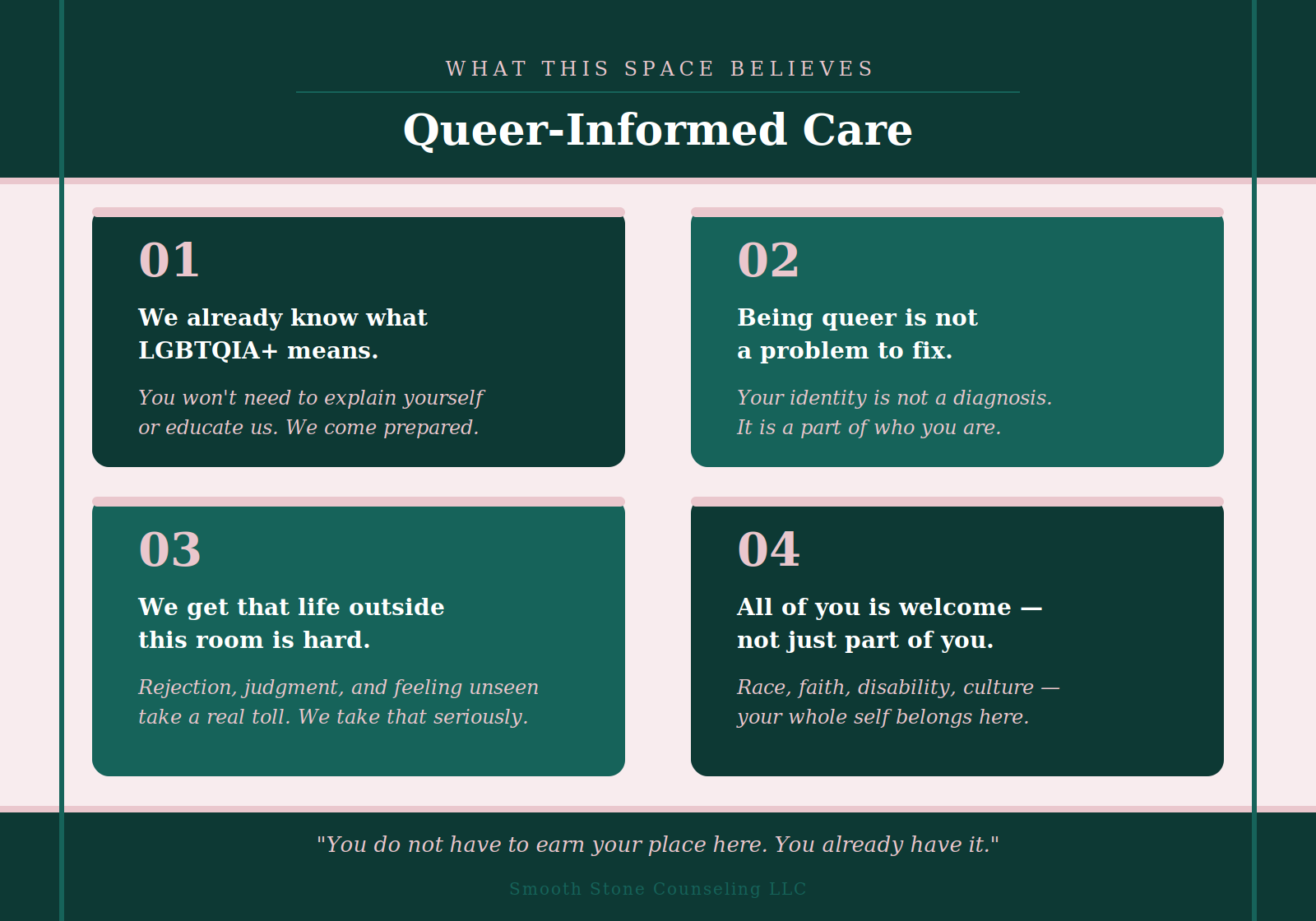
Image generated using Anthropic, Claude 2025
How to Find a Truly Affirming Provider
Searching for a therapist can feel overwhelming under the best of circumstances. For queer adults, it carries an additional layer of risk; a bad therapeutic relationship can actively cause harm. Here are practical steps to find a provider who is genuinely prepared to work with you.
Use LGBTQ-Specific Directories
While there is no current standardized way to tell if a therapist is fully queer-informed. Start with directories designed specifically for this purpose. Psychology Today's filter for "LGBTQ+" is a starting point, maybe a general internet search or asking your insurance provider can also be helpful but more curated options include:
GLMA (GLMA: Health Professionals Advancing LGBTQ+ Equality) — providers who have specifically committed to LGBTQ+ competency
TherapyDen — specifically built around inclusive, affirming providers with strong filtering by identity
National Queer and Trans Therapists of Color Network — for QTBIPOC clients seeking culturally responsive care
AASECT (American Association of Sexuality Educators, Counselors and Therapists) — for concerns related to sexuality and relationships
If you live in the UK, Pink Therapy is the largest GSRD -Gender, Sex and Relationship Diversity- network of independent specialist therapists in the UK.
Ask Direct Questions Before Committing
Most therapists offer a free consultation call or an email before an intake. Use it.
Questions worth asking:
What training have you completed specifically in LGBTQ+ mental health?
Have you worked with clients who are trans or nonbinary? Bisexual? Asexual?
How do you approach a client who is in the middle of identity exploration and doesn't have a settled label?
How do you stay current on LGBTQ+ issues and communities?
Pay attention not just to the answers but to how the therapist responds. Do they answer confidently and specifically, or do they offer vague reassurances? Do they seem defensive? Do they ask you questions in return that suggest genuine curiosity?
Trust Your Own Signals
You are the expert on your own experience. Early sessions are as much about you evaluating the therapist as they are about the work. Notice:
Do you find yourself editing what you say to protect the therapist's comfort?
Do they use your correct pronouns and language without being corrected?
Do they seem genuinely knowledgeable, or are you finding yourself constantly educating them?
Does the space feel genuinely safe, or merely polite?
A therapist who is a good fit won't require you to perform a lesser version of yourself to make them comfortable. If something feels off in early sessions, it's worth naming it directly or looking elsewhere. The right provider exists, and you deserve to find them.
“For LGBTQIA+ adults, affirming care is not a bonus feature; it is the baseline standard. You deserve a therapist who already knows that before you walk in the door.”
A Final Word
If therapy hasn't felt right before, that experience is valid, and it's also not the whole story. Finding a provider who is genuinely prepared for you makes a real difference, and that's exactly what this article is supposed to help you obtain. The mental health challenges facing LGBTQIA+ communities are real, and so is the possibility of care that meets them. You deserve a therapist who already knows how to show up for you, so you can focus on the work.
Want to learn more? Have an idea for a blog topic? Reach out!
I personally recommend these excellent books:
**If you purchase these books using these links, then I will receive a small commission:
EMDR: If you are working through trauma and considering EMDR, 5 hrs 2 mins. (Link here)
If you want a more clinical approach + self-help tips written by the creator of the modality. 12 hrs 2 mins(Link here)
Panic and Severe Anxiety: If you want a step-by-step structure to help end panic attacks, I’ve seen this book change lives. 6hr 19 mins. (Link here)
General Emotional Intelligence: Simple advice we all need to hear again. 3hr 44 mins. (Link Here)
For adult children of emotionally immature parents. 6hr 50mins. (Link Here)
IFS “Parts work”: If you have an imagination and are ready for deep work, and want to increase self-compassion. 8 hrs 10 mins. (Link Here)



This handout breaks down 7 early warning signs of psychosis in language that actually makes sense to young people.
No clinical jargon, no scare tactics — just clear, relatable descriptions a high schooler or college student can read and recognize.
Includes a plain-language reminder that these signs don't equal a diagnosis, and a simple prompt to talk to a trusted adult. Print it, post it, or share it digitally.
-For Canva copy to edit colors, etc., please email us. Pricing slightly increases for this featured version.