
When You Have No Idea How to Help ( A Loved One) Anymore
There's a specific kind of exhaustion that nobody really talks about.
It's not the kind you get from working too many hours or not sleeping enough. It's the kind that settles into your chest when you've tried everything — every conversation, every approach, every version of yourself — and the person you love most is still struggling. And you're standing there, completely out of ideas, wondering when exactly you stopped knowing what to do.
If you're a parent, maybe this looks like watching your kid spiral and not recognizing them anymore. Maybe it's the distance in their eyes, the doors that stay closed, the conversations that go sideways no matter how carefully you choose your words. You used to be the person who could fix things. Now you can't even get them to talk to you.
But here's what I want to say before we go any further: you don't have to be a parent to feel this.
Maybe it's a partner you've loved for years, and somewhere along the way, the connection started fraying, and you don't know when it happened or how to get back. Maybe it's a friend you've watched fade into someone you barely recognize. Maybe it's a sibling, a parent of your own, someone you've poured yourself into for so long that you've lost track of where they end and you begin.
The feeling is the same. I love this person. I don't know what to do anymore. And I'm terrified that means I've already failed them.
The Shame Nobody Admits To
Here's the part that's hardest to say out loud.
When you can't help someone you love, it doesn't just feel sad. It feels like your fault. Like if you were smarter, more patient, more intuitive — if you'd said something different two years ago, or last week, or yesterday — things would be different.
Parents carry this in a particularly brutal way. Society has this unspoken rule that a good parent knows. They sense when something's wrong. They say the right thing. They show up in exactly the way their child needs. And when that doesn't happen? When you're sitting across from your kid at dinner, and the silence between you feels like a wall you don't know how to climb? The shame is crushing.
But the same thing happens in marriages. In friendships. In any relationship where you've decided that this person matters enough to fight for. You start replaying every moment, cataloguing your failures, wondering if the fact that you don't know what to do is itself the problem.
It isn't. But I know that's hard to believe right now.
The Fear Underneath the Confusion
Underneath the confusion is usually fear.
Fear that it's too late. Fear that the distance has become permanent. Fear that the person you're trying to reach has already decided — consciously or not — that you're not safe, not helpful, not enough. Fear that your love, however real it is, just isn't the right shape for what they need.
And sometimes, the scariest fear of all: what if they're right?
What if you've been showing up in ways that weren't actually helpful? What if the way you learned to love — the way you were taught, by your own parents, your own relationships, your own survival — is actually part of the problem?
That's a gutting thought. It's also one that takes real courage to sit with.
What to Do When You Don't Know What to Do
So where does that leave you?
First: You are in better company than you think. The people who are most sure they know exactly how to help are often the ones doing the most damage. The fact that you're uncertain, that you're questioning yourself, that you care enough to be reading something like this — that matters. It's not nothing.
Second: stop trying to fix it alone.
I mean this genuinely. There is no amount of love, intention, or research that fully prepares you to navigate someone else's pain, especially when that pain is tangled up in your relationship with them. Whether it's therapy for yourself, family counseling, couples work, or simply finding a support group of people who get what you're going through — reaching out isn't giving up. It's the opposite.
Third: ask yourself what they actually need, not what you think they need.
Sometimes we help in the ways that feel natural to us — advice, problem-solving, presence, space — without stopping to ask if that's what the other person actually needs from us. It's uncomfortable to realize you might have been offering the wrong kind of help. But it opens a door.
And fourth: give yourself some grace.
Odds are, you are not a trained therapist, and if you are, your loved one could never be your client. You are not omniscient. You are a human being who loves another human being, and that is both the most powerful thing in the world and also not always enough — not because you're lacking, but because love alone can't do everything. Sometimes people need professional support. Sometimes they need time. Sometimes the most loving thing you can do is stay close without trying to steer.
You Haven't Failed Just Because You're Lost
I want to end here, because I think it's the thing most people need to hear and almost nobody says:
Being confused doesn't mean you've failed. Not knowing what to do next doesn't mean you've given up. Feeling scared doesn't mean you're weak.
It means you're human. It means you care. And it means you're still in it — still showing up, still trying to figure out how to reach someone who matters to you.
That's not nothing. In fact, right now, it might be everything.
If you're in this place — whether you're a parent, a partner, a friend, or anyone trying to love someone through something hard — know that you're not alone. And know that getting support for yourself isn't selfish. It might just be the first step toward being able to actually help.
If this resonated with you, share it with someone who might need it. And if you're struggling, please consider reaching out to a therapist or counselor — for you, not just for them. You deserve support too.
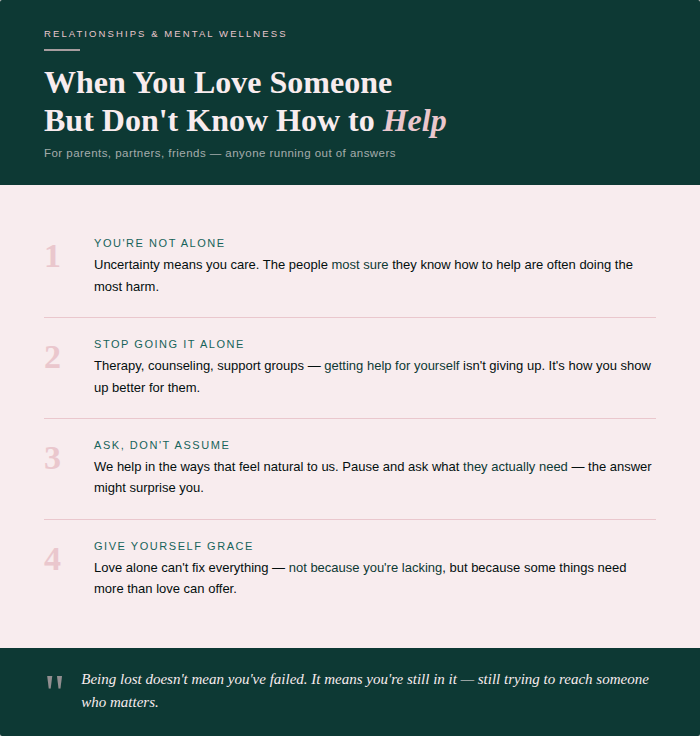
Image generated using Anthropic, Claude 2025



This handout breaks down 7 early warning signs of psychosis in language that actually makes sense to young people.
No clinical jargon, no scare tactics — just clear, relatable descriptions a high schooler or college student can read and recognize.
Includes a plain-language reminder that these signs don't equal a diagnosis, and a simple prompt to talk to a trusted adult. Print it, post it, or share it digitally.
-For Canva copy to edit colors, etc., please email us. Pricing slightly increases for this featured version.