
When Is Anger a Mental Health Concern?
Anger is one of the most misunderstood emotions. It’s often labeled as “bad,” “toxic,” or something to suppress. But anger itself isn’t the problem. In fact, anger is a normal, healthy emotional response.
The real question is: when does anger shift from healthy to harmful?
If you’ve ever wondered whether your reactions qualify as uncontrollable anger or whether anger management therapy might help, this guide will walk you through the difference between normal anger and anger that signals a deeper mental health concern.
Healthy Anger vs. Dysregulated Anger
Healthy Anger
Healthy anger:
Signals that a boundary has been crossed
Motivates problem-solving
Is proportional to the situation
Can be expressed without harming others
For example, feeling angry when someone disrespects you is normal. Expressing that anger calmly and assertively is emotionally healthy.
Anger becomes useful when it helps you advocate for yourself.
Dysregulated Anger
Anger becomes a mental health concern when it is:
Intense and disproportionate
Frequent and difficult to control
Followed by shame or regret
Damaging to relationships, work, or self-image
Accompanied by physical aggression or verbal explosions
Many people struggling with uncontrollable anger describe feeling like something “takes over” in the moment. The reaction feels automatic, fast, and overwhelming.
This is where anger management therapy becomes more than a self-help tool; it becomes a form of nervous system regulation and deeper emotional healing.
The Neurobiology of Anger: Why It Feels So Fast
To understand anger problems — especially anger problems in men, which are often socially reinforced or minimized — we need to look at the brain.
When you perceive a threat (physical or emotional), the brain’s amygdala activates. This region is responsible for threat detection and survival responses. It triggers:
Adrenaline release
Increased heart rate
Muscle tension
Narrowed attention
At the same time, the prefrontal cortex (the part responsible for reasoning and impulse control) can temporarily go offline.
This is why anger can feel instant and overwhelming. It’s not just a personality issue. It’s a nervous system response.
For individuals with trauma histories, chronic stress, or early emotional neglect, this system can become hypersensitive. The brain learns to detect danger where others might not.
In these cases, anger is not random; it’s protective.
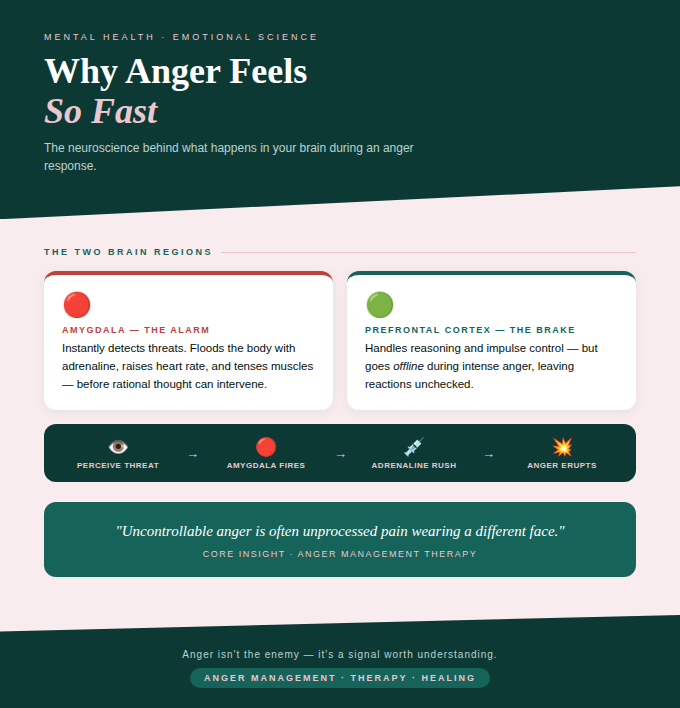
Image generated using Anthropic, Claude 2025
Trauma and Anger: The Missing Link
Many people seeking anger management therapy discover something surprising:
Their anger isn’t the root problem. It’s the surface symptom.
Trauma, whether from childhood neglect, emotional abuse, bullying, or chronic invalidation, often creates a nervous system that lives in fight-or-flight mode.
Anger can become:
A defense against vulnerability
A shield against shame
A way to regain control
A learned survival strategy
This is especially common in conversations about anger problems in men. Many boys are socialized to suppress sadness, fear, and tenderness. Anger becomes the only socially acceptable emotional outlet.
When softer emotions are buried, they often resurface as irritability, rage, or emotional shutdown.
Uncontrollable anger is often unprocessed pain.
When Should You Seek Help?
Consider professional support if:
Loved ones say they feel afraid of your reactions
You experience blackouts or memory gaps during arguments
You’ve damaged property or become physically aggressive
You feel constant irritability or resentment
You feel ashamed after outbursts but can’t seem to stop
Seeking therapy is not an admission of failure. It’s a commitment to emotional maturity and relational safety.
Effective Therapy Approaches for Anger
1. Cognitive Behavioral Therapy (CBT)
CBT helps identify the thought patterns that fuel anger.
For example:
“They’re disrespecting me on purpose.”
“No one ever listens.”
“I’m being attacked.”
CBT teaches cognitive restructuring, learning to pause, question interpretations, and choose a different response.
It’s highly effective in structured anger management therapy programs.
2. Dialectical Behavior Therapy (DBT)
DBT focuses on emotional regulation and distress tolerance.
Skills include:
Pausing before reacting
Identifying triggers
Practicing opposite action
Developing interpersonal effectiveness
DBT is especially helpful for people who experience anger as sudden and explosive.
3. Somatic and Nervous System Work
Because anger is physiological, cognitive tools alone are sometimes not enough.
Somatic approaches focus on:
Body awareness
Breath regulation
Muscle tension release
Tracking activation levels
Learning to recognize the early physical cues of anger: clenched jaw, tight chest, shallow breathing, allows intervention before escalation.
For individuals with trauma-related anger, this body-based work is often transformative.
Final Thoughts: Anger Isn’t the Enemy
Anger is not inherently unhealthy.
But when anger feels uncontrollable, damaging, or deeply rooted in past pain, it deserves attention, not suppression.
If you’re struggling with anger problems, repeated relationship conflict, or cycles of shame after outbursts, therapy can help you understand what your anger is protecting.
Underneath anger is often hurt.
Underneath hurt is often unmet need.
And therapy creates space to address both.
Healing anger doesn’t mean becoming passive.
It means becoming regulated, self-aware, and powerful in a way that builds connection rather than destroys it.



This handout breaks down 7 early warning signs of psychosis in language that actually makes sense to young people.
No clinical jargon, no scare tactics — just clear, relatable descriptions a high schooler or college student can read and recognize.
Includes a plain-language reminder that these signs don't equal a diagnosis, and a simple prompt to talk to a trusted adult. Print it, post it, or share it digitally.
-For Canva copy to edit colors, etc., please email us. Pricing slightly increases for this featured version.