
Understanding Passive Suicidal Ideation: What It Is and Why It Matters
You're exhausted. Life feels impossibly heavy. And somewhere in the back of your mind, a thought creeps in: "I just don't want to be here anymore." Or maybe: "Everyone would be better off without me." Or simply: "I wish I could fall asleep and not wake up."
If any of that sounds familiar — first, you're not alone. And second, what you're experiencing has a name: passive suicidal ideation (SI). It's more common than most people realize, and it doesn't make you broken, dangerous, or destined for a psychiatric hospital. What it does mean is that your mind is signaling that something needs more support. That signal is worth listening to.
Let's talk about what passive suicidal ideation actually is, why it happens, and, most importantly, what to do about it.
What Is Passive Suicidal Ideation?
Suicidal ideation exists on a spectrum. On one end, you have passive suicidal ideation — thoughts about not wanting to be alive, wishing for death, or imagining disappearing, without any specific plan or intent to act. On the other end, there is active suicidal ideation, which involves a concrete plan or intention to end one's life.
Passive SI is extraordinarily common during periods of intense emotional pain. Grief, burnout, depression, trauma, loneliness, chronic illness — any of these can trigger thoughts like "I can't do this anymore" or "I just want it all to stop." Research suggests that a significant portion of the general population has experienced passive suicidal thoughts at some point in their lives. This doesn't make those thoughts any less serious, but it does mean you are far from alone.
The important thing to understand is this: having passive SI does not automatically mean you are in immediate danger, and it does not automatically mean you need to be hospitalized. It means you're hurting, and you deserve support.
Suicidal Ideation as a Coping Skill (Yes, Really)
This might sound surprising, but here's something clinicians understand well: suicidal ideation, and even a suicide attempt, can function as a type of coping skill.
Not a good one. Not an effective one. But a coping skill nonetheless.
When emotional pain becomes unbearable, and a person runs out of other ways to manage it, the mind sometimes fixates on "escape" as a solution. The thoughts aren't necessarily about wanting to die; they're often about desperately wanting the pain to stop. SI can temporarily provide a sense of control or relief in the moment: "If things get bad enough, I have a way out." That thought, however harmful, can paradoxically help some people get through the next hour.
Understanding this is actually empowering. It means that if you're experiencing SI, your brain isn't malfunctioning — it's doing its best to manage unbearable feelings with a very limited toolkit. The goal, then, isn't to shame yourself for the thoughts. It's to build a bigger, better toolkit.
When you have more effective coping skills — grounding techniques, emotion regulation strategies, a strong support network, therapy — the SI often decreases naturally, because the mind no longer needs that particular escape hatch.
Do I Need Therapy for Suicidal Thoughts?
Short answer: yes, talking to a therapist about passive suicidal thoughts is genuinely important, and it doesn't have to be as scary as it sounds.
Many people avoid bringing up SI because they're afraid of what will happen. They worry they'll be "reported," hospitalized against their will, or that the therapist will panic. So they stay silent, and the thoughts grow heavier in the dark.
Here's what most people don't know: a good therapist is not going to automatically send you to the hospital for having passive suicidal thoughts. Therapists are trained to assess SI regularly. They will ask you questions about the nature of your thoughts, whether you have a plan, whether you have intent, and what your support system looks like. Passive ideation without a specific plan is addressed in outpatient therapy every single day.
Telling your therapist about SI opens the door to:
Identifying the underlying pain driving the thoughts
Learning concrete coping skills to manage overwhelming emotions
Building a safety plan: a personalized roadmap for what to do when things get hard
Feeling less alone with something that has likely been incredibly isolating
If you don't have a therapist yet and you're experiencing passive SI, this is exactly the kind of thing therapy is designed for. Searching for a therapist can feel overwhelming when you're already struggling, so start small: check database websites, check your insurance's provider list, learn about superbills to see someone out of network, ask your doctor for a referral, or look into platforms that offer sliding-scale or teletherapy options. Therapy is much more accessible now than before.
What About Hospitalization? When Does That Actually Happen?
Let's be real: the fear of being hospitalized is one of the biggest reasons people don't speak up about suicidal thoughts. So let's demystify it.
Hospitalization is typically considered when someone has active suicidal ideation with a specific plan, access to means, and intent to act — meaning there is a serious, imminent safety concern. Passive suicidal thoughts: "I don't want to be here" without a plan, are generally not grounds for involuntary hospitalization.
That said, going to a psychiatric hospital can be genuinely helpful for some people, and it's worth knowing what that actually looks like if it ever becomes relevant to you or someone you love.
A typical inpatient psychiatric stay lasts anywhere from a few days to about a week, though it can vary based on individual needs and circumstances. It is not, as TV would have you believe, a bleak and punitive experience for everyone. Many people describe their stay as a much-needed pause, a place to stabilize, sleep, get medications adjusted, and start learning skills in a structured environment.
During a stay, you'll typically have access to group therapy, individual check-ins with a psychiatrist, and some psychoeducation. The goal is stabilization and building a plan for after discharge — including outpatient (meaning out of the hospital) therapy, medication management if needed, and a safety plan. It's a beginning, not an ending.
The experience varies widely depending on the facility, and it's not the right fit for everyone. But for someone in acute crisis, it can be genuinely life-saving.
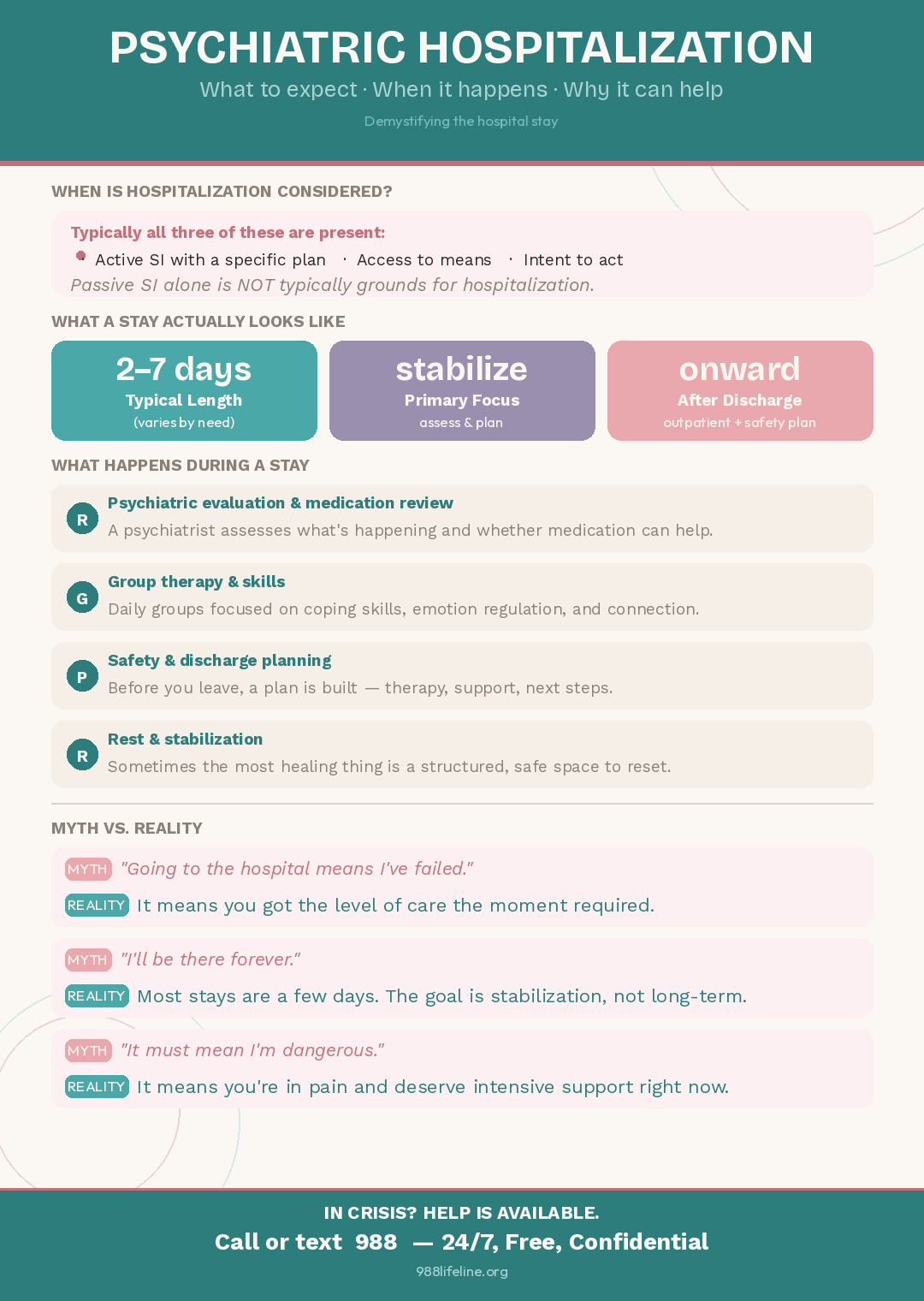
Image generated using Anthropic, Claude 2025
What to Do If You're Having Passive Suicidal Thoughts Right Now
You don't need to be in crisis to take this seriously. Here's a starting point:
Tell someone safe. This is the hardest and most important step. A therapist, a doctor, a trusted friend or family member — someone who can help you not carry this alone.
Practice other coping skills. When passive SI shows up, it's a signal that your current coping strategies aren't enough for what you're carrying. That might look like: deep breathing, physical movement, calling someone, journaling, grounding exercises (naming 5 things you can see, 4 you can touch, etc.), slowing down your life, or reaching out to a crisis line just to talk.
Build a safety plan. A safety plan is a written guide you create with a therapist or counselor that outlines your personal warning signs, coping strategies, people to call, and steps to take when thoughts escalate. Having one means you don't have to figure it out in the moment.
Be compassionate with yourself. Passive suicidal ideation is not a character flaw. It is a sign that you are carrying more pain than your current support system can hold. You deserve more support, not more shame.
For Partners, Parents, and Loved Ones Reading This
If someone you love has shared that they're having passive suicidal thoughts, the most important thing you can do is stay calm and stay present. Thank them for telling you. Ask how you can help. Encourage them to talk to a therapist or doctor, and offer to help them find one if needed.
You don't need to fix it. You just need to not make them regret telling you.
A Final Word
Passive suicidal thoughts are a signal, not a sentence. They are your mind's way of saying: "I am in more pain than I know how to handle right now." That message deserves to be heard — by you, by a therapist, and by the people who care about you.
You don't have to have it all figured out. You just have to take one next step: tell someone.
If you or someone you know is in crisis right now, please reach out to the 988 Suicide & Crisis Lifeline by calling or texting 988. You can also chat at 988lifeline.org. Help is available 24/7. If your country does not have 988, then search out a similar number to call or resourse to pursue. You are not alone, and people are here for you.
This post is intended for informational purposes and does not constitute clinical advice for an individual. If you are experiencing suicidal thoughts, please speak with a licensed mental health professional.



This handout breaks down 7 early warning signs of psychosis in language that actually makes sense to young people.
No clinical jargon, no scare tactics — just clear, relatable descriptions a high schooler or college student can read and recognize.
Includes a plain-language reminder that these signs don't equal a diagnosis, and a simple prompt to talk to a trusted adult. Print it, post it, or share it digitally.
-For Canva copy to edit colors, etc., please email us. Pricing slightly increases for this featured version.