
Why Emotional Regulation Can Feel Harder Later in Life (Especially for Gen X and Boomers)
For many adults in their 40s, 50s, 60s, and beyond, something surprising can happen:
Emotions that once felt manageable begin to feel sharper.
Irritability increases.
Patience shortens.
Shutdown happens faster.
Old memories feel closer to the surface.
This isn’t a personal failure.
And it isn’t a generational flaw.
It is often the result of decades of accumulated stress, changing life roles, and a cultural era that did not prioritize emotional education.
Every generation has its struggles. But many Gen X and Baby Boomers were raised during a time when mental health simply wasn’t talked about openly — and when it was, it was often stigmatized.
Understanding emotional regulation in this context can be both validating and relieving.
What Is Emotional Regulation?
Clinically, emotional regulation refers to the ability to:
Recognize emotions as they arise
Tolerate distress without becoming overwhelmed
Adjust emotional intensity appropriately
Respond thoughtfully rather than react impulsively
It is not about being calm all the time.
It is about flexibility.
Emotional dysregulation occurs when:
Reactions feel fast or intense
It takes a long time to calm down
Anger or shutdown overrides communication
Stress feels physically overwhelming
For older adults, dysregulation may show up as irritability, withdrawal, tension, or estrangement in relationships, or difficulty adapting to change.
The Generational Context: Why This Makes Sense
There is no evidence that Gen X or Boomers are inherently more prone to emotional problems or personality disorders.
However, many were raised in environments where:
Emotional vulnerability was discouraged
“Toughness” was valued over expression
Therapy was rare or stigmatized
Therapy was still gathering data on disorders and treatment modalities
Many therapists may have unintentionally caused harm while believing they were effectively treating a disorder
Trauma was normalized or minimized
Parenting styles were often authoritarian or emotionally reserved
In many households, the message was:
“Push through.”
“Handle it yourself.”
“Don’t dwell on it.”
For children growing up in that environment, suppression became a survival skill.
And suppression works…for a while.
But emotions that aren’t processed don’t disappear. They get stored.
As life slows down later, through retirement, health changes, caregiving shifts, or loss. There is often more psychological space. Old patterns surface not because someone is weak, but because the nervous system finally has room to speak.
This isn’t blame.
It’s context.
Emotional Regulation and Older Men
Many older men were raised during a time when strict cultural norms around masculinity limited emotional expression. Expressing sadness, fear, or vulnerability was often equated with weakness, while emotional restraint and control were praised.
These patterns can emerge decades later as:
Irritability or frustration
Emotional numbing
Anger or quick escalation
Withdrawal or avoidance
Historical social norms also reinforced problematic attitudes: homophobia, sexism, and racism were widely accepted, limiting opportunities to process complex emotions. Men were socialized to suppress empathy for marginalized groups, which further reduced emotional literacy.
Sexuality was also heavily policed. Older men who experienced same-sex attraction or gender non-conforming tendencies often learned to hide or deny these feelings. Suppressing core aspects of identity can intensify emotional dysregulation over time.
Anger is often a protective secondary emotion shielding grief, fear, shame, or internal conflict. Understanding this can reduce self-blame and open the door to growth. Therapy offers a safe space to unpack decades of conditioned responses and unprocessed experiences.
Neurodivergence and Late-Life Burnout
Many neurodivergent adults, especially those diagnosed later in life, spent decades masking their differences to fit expectations.
Chronic masking can:
Exhaust regulatory capacity
Increase irritability
Heighten sensory overwhelm
Lead to emotional shutdown
Unlike many cisgender women, who were often socialized to verbalize emotions, men and some neurodivergent individuals were taught to internalize or redirect distress.
It is also important to note that research on emotional regulation has primarily focused on cisgender men and women. There is still limited data on regulation patterns in gender queer and nonbinary populations, though minority stress is increasingly recognized as a significant factor.
The Trauma Connection
Trauma plays a critical role in emotional regulation.
The brain’s amygdala detects threat.
The prefrontal cortex helps regulate emotional responses.
Research shows that chronic or early trauma can:
Increase amygdala reactivity
Reduce prefrontal regulatory control
Heighten baseline nervous system activation
McLaughlin et al. (2015, Biological Psychiatry) found that childhood adversity is associated with alterations in neural circuits responsible for emotion regulation.
Teicher & Samson (2016, American Journal of Psychiatry) documented structural and functional changes in brain regions governing emotional modulation following early maltreatment.
Herringa et al. (2013, JAMA Psychiatry) demonstrated disrupted connectivity between the amygdala and prefrontal cortex in trauma-exposed youth, weakening emotional control systems.
In simple terms:
Trauma can strengthen the alarm system while weakening the braking system.
For individuals who never had the opportunity to process earlier life stressors, later-life transitions can reactivate those neural pathways.
Again, this is not a character flaw.
It is neurobiology shaped by experience.
A New Era of Mental Health
Today’s mental health landscape is different.
We now have:
Trauma-informed therapy
Emotional regulation skill training
Attachment science
Neurodivergent-affirming frameworks
Broader conversations about masculinity and vulnerability
Many Gen X and Boomers are only now discovering language for experiences they’ve carried for decades.
It is common to hear:
“I didn’t know this had a name.”
“I thought this was just who I was.”
“I didn’t realize this could change.”
There is something powerful about finding relief later in life, not because you failed before, but because the tools simply weren’t widely available.
When to Consider Emotional Regulation Therapy
Support may be helpful if you notice:
Persistent irritability
Escalating relationship conflict
Emotional shutdown
Difficulty calming once activated
A sense of being stuck in the same reactions for years
Anger that feels disproportionate
Emotional regulation can be strengthened at any age.
Neuroplasticity continues throughout adulthood.
Change remains possible.
It is not about becoming someone different.
It is about understanding how your nervous system was shaped and learning how to work with it in a way that brings more stability, clarity, and relief.
You don’t have to face decades of accumulated stress alone. Contact Smoothstone Counseling today to explore therapy that helps you strengthen emotional regulation and find the relief you may have been missing for years.
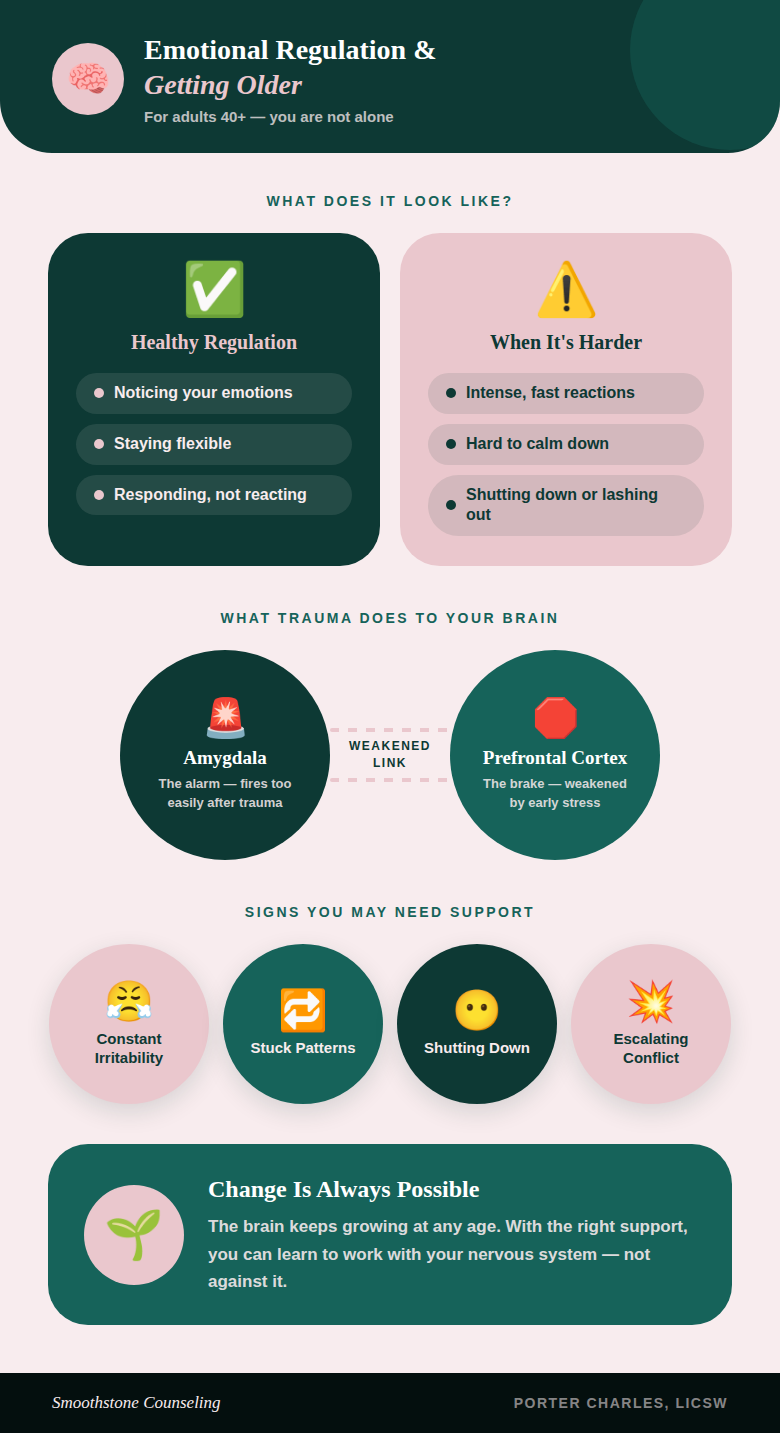
Image generated using Anthropic, Claude 2025
Want to learn more? Have an idea for a blog topic? Reach out!
I personally recommend these excellent books:
**If you purchase these books using these links, then I will receive a small commission:
EMDR: If you are working through trauma and considering EMDR, 5 hrs 2 mins. (Link here)
If you want a more clinical approach + self-help tips written by the creator of the modality. 12 hrs 2 mins (Link here)
Panic and Severe Anxiety: If you want a step-by-step structure to help end panic attacks, I’ve seen this book change lives. 6hr 19 mins. (Link here)
General Emotional Intelligence: Simple advice we all need to hear again. 3hr 44 mins. (Link Here)
For adult children of emotionally immature parents. 6hr 50mins. (Link Here)
IFS “Parts work”: If you have an imagination and are ready for deep work, and want to increase self-compassion. 8 hrs 10 mins. (Link Here)



This handout breaks down 7 early warning signs of psychosis in language that actually makes sense to young people.
No clinical jargon, no scare tactics — just clear, relatable descriptions a high schooler or college student can read and recognize.
Includes a plain-language reminder that these signs don't equal a diagnosis, and a simple prompt to talk to a trusted adult. Print it, post it, or share it digitally.
-For Canva copy to edit colors, etc., please email us. Pricing slightly increases for this featured version.